Africa | Europe | Middle East | South Asia | China | Latin America | Nordic
Angkors Away: Three Days Inside the Greatest Temple Complex on Earth
Cambodia + Bangkok | Siem Reap + Bangkok layover | May 2014
We'd seen Angkor Wat in the background of every travel poster and magazine for years before we actually went. You become almost numb to an image when you see it that many times. And then you turn a corner in a taxi from the Siem Reap airport and catch your first actual glimpse of it in the distance, and all that familiarity evaporates completely. We were giddy. Genuinely, unabashedly giddy.
Our hotel, the Pavilion D'Orient, came with something I want to specifically recommend to anyone planning this trip: a dedicated tuk tuk driver for the duration of the stay. Ours was named Poev, and he was a person of enormous smiles and endless patience. A tuk tuk is a four-seat cart attached to a motorbike, and it is the perfect way to move around Siem Reap: open to the air, immediate natural air conditioning at any speed, and completely capable of navigating roads that would challenge larger vehicles. It also just screams Cambodia in the best way.
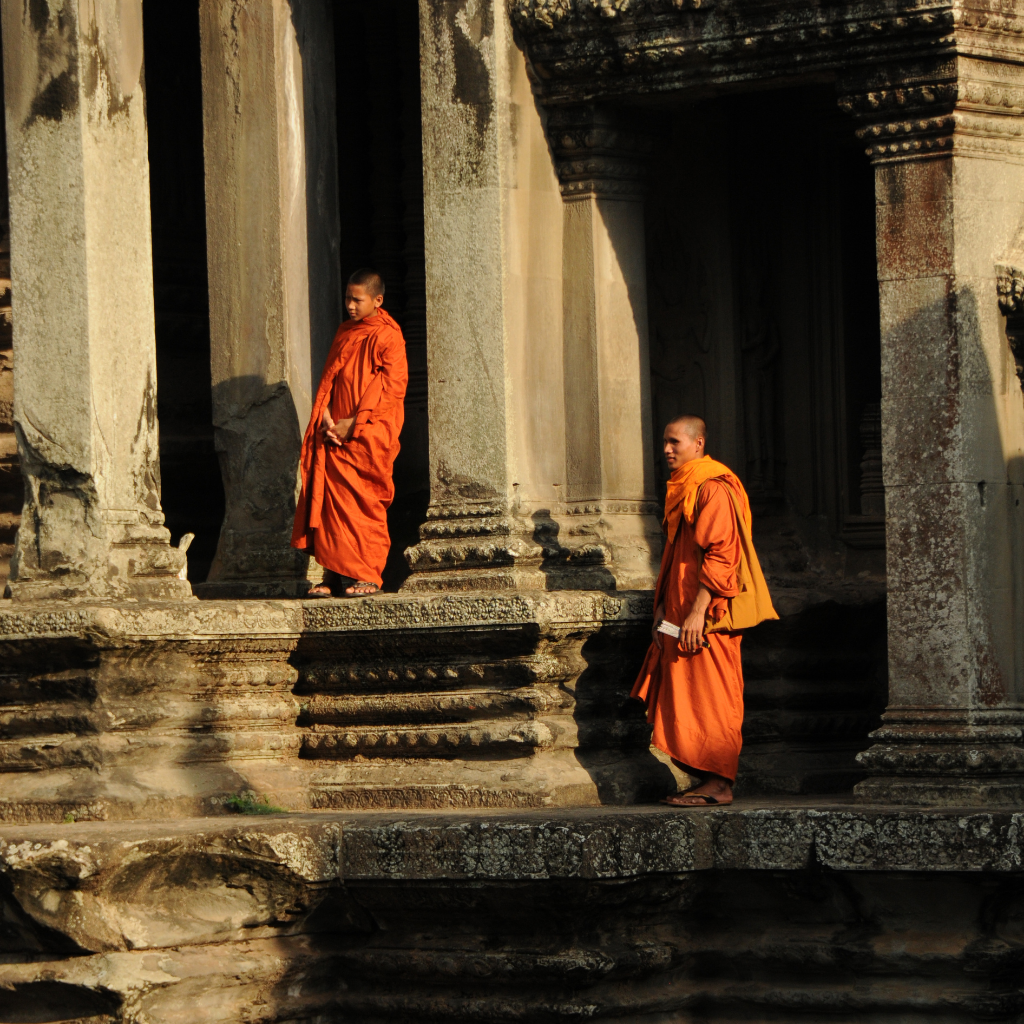
Angkor Wat itself. The largest religious monument in the world, built in the early 12th century, best preserved of all the temples in the complex and the only one that has remained an active religious site since it was built. Most people know it from the movie Tomb Raider (we rewatched it right before coming, obviously). What no movie quite captures is the scale, and what photographs miss entirely is the density of the carving. Every surface. Every wall, every column, every inch. Reliefs of mythological scenes, battles, daily life, all rendered with a level of detail that makes you stop and lean in again and again.
The temples are not close together, which we figured out by attempting to walk between Angkor Wat and Angkor Thom and realizing after some time that our map was not to scale. Poev collected us without complaint and drove us over.
Angkor Thom's south gate entrance is approached across a moat lined on both sides by rows of figures carrying the body of a giant serpent in what looks almost like a tug of war. The Bayon temple inside is famous for its towers, most of them carved with four enormous faces on each cardinal point. Hundreds of faces looking serenely in every direction. Standing inside it in the late afternoon light was one of the stranger and more beautiful experiences of the trip.
We did the 5am sunrise visit the second morning because Matt wanted to try for photographs and honestly because I can't remember the last time I actually watched the sun rise. I mean sat and watched from the first grey light through the moment it clears the horizon. We should all do this more. We don't.
Being up early also meant we got to Ta Prohm before most of the crowds. Ta Prohm is the temple where the massive Banyan tree roots have grown over and through the ruins over centuries, and it is remarkable. Also famously in Tomb Raider. We are Tomb Raider pilgrims apparently. The trees have essentially become structural elements now, holding up walls and archways through sheer biological persistence. It was one of our favorite sights of the whole trip.
The temples require real physical commitment in the heat. You're climbing uneven stone stairs, scrambling across ancient formations, navigating passages that weren't necessarily designed with modern tourists in mind. In that way it felt exactly like Machu Picchu, this combination of sightseeing and genuine physical adventure that makes you feel like an explorer rather than a visitor.
Banteay Srei was a 27-kilometer tuk tuk ride outside Siem Reap that was absolutely worth it. Built in the 10th century, older than Angkor Wat, dedicated to the Hindu god Shiva, and called the Citadel of Beauty. It earns the name. Where Angkor Wat is immense, Banteay Srei is intimate: smaller in scale but covered in some of the finest stone carving we saw anywhere. The pink sandstone it's built from gives it a different quality in the light. Get there early, go.
Banteay Srei also had the luxury of a visitor center with actual flush toilets, which deserves special recognition because the bathroom situation at Angkor is essentially two toilets for the entire complex and most of them involve a bucket of water and a pot for manual flushing. You calibrate accordingly and develop a certain philosophical acceptance of the whole situation.
On the way back we stopped at the Cambodian Land Mine Museum, which was a genuine gut punch. There are estimated to be more than three million unexploded land mines remaining in Cambodia. The museum is in front of a complex that houses and educates children who are victims, whether through injury or orphanhood. We had seen bands of blind and disabled musicians near the temples raising money for victims throughout the trip. Understanding the scope of the problem at the museum made those encounters land much harder.
The streets between the hotels and the temples were full of things to see and adjust to: motorbikes everywhere with entire families aboard and nobody wearing helmets; gas sold in old liquor bottles and soda bottles at roadside stands; children as young as three or four selling souvenir magnets with their learned English phrase of "two for one dollar?" because school is not an option for every child here. You see these things and you feel them. They don't become background noise. Every time we travel to a place like this, the same thing happens: I feel grateful in a way that stays with me long after I've come home.
Pub Street in Siem Reap is where the tourist nightlife concentrates, two car-free streets packed with restaurants, bars, massage places, and vendors who will follow you half a block saying "Lady, look, free to look, you want scarf?" Draft beer was fifty cents. Our full dinner for two, stuffed and with drinks, came to $14.50. We ate pomelo salad with prawns that was genuinely excellent, chicken with hot basil, fried spring rolls, pork fried rice. Matt wandered around photographing vendors selling insects to eat while I got a foot massage for two dollars for thirty minutes. We had the Tuk Tuk back to the hotel at 9:30pm and crashed immediately.
Matt also made a very thorough investigation of the Durian fruit situation. Durian, if you've never encountered it, has spikes on the outside and a flesh inside that has been described as smelling of rotten onions, turpentine, and raw sewage. They ban it from hotels and public transportation across Southeast Asia. Matt finds the smell appealing. I find Matt's affinity for Durian to be one of the more perplexing things about being married to him. We are otherwise very compatible.
What Cambodia does, what it has in common with China and Egypt and Jordan and Peru, is turn every one of your senses to maximum simultaneously. There are sights and sounds and smells and tastes and physical sensations all happening at once, all of them new, all of them demanding your attention. It wakes your brain up. It challenges you past points you thought were your limits. It makes you feel more alive than almost any other experience I know. That is why we travel. Not just to see things, but to feel fully, completely present in a world that is so much bigger and more varied than any one life can contain.
We flew to Bangkok with a layover before our long flight home, and even our single half-day there managed to be memorable. A tour counter at the airport offered us a custom driver for just over a hundred dollars, which we jumped on. Our driver was an older man with the longest hairs I have ever seen growing from a mole on his chin, approximately ten inches in length, and a laugh that punctuated every single thing he said. He reminded us both immediately of Victor Wong in The Golden Child. "Give me the knife!" He was wonderful.
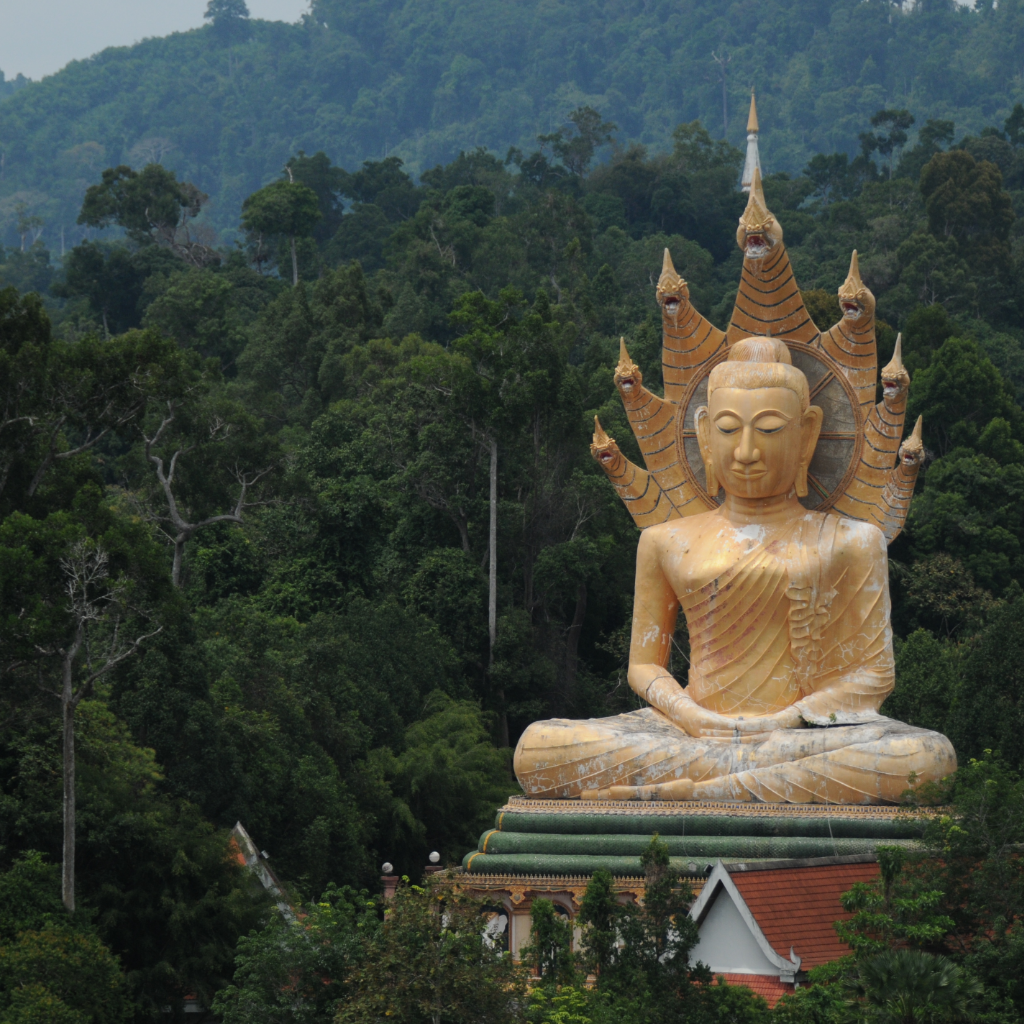
He drove us past the Parliament Building, the Royal Palace (already closed but lit up beautifully), and then to Wat Pho, home of the Reclining Buddha. Nobody tells you how big the Reclining Buddha actually is. Huge doesn't cover it. Magnificent doesn't quite cover it either. You stand there looking at this golden figure stretching across the entire length of an enormous hall and you genuinely cannot process the scale of it. We also got to sit in on a live Buddhist ceremony for a while, which was quiet and rhythmic and unexpectedly moving.
Dinner was at a restaurant on the water called "In Love," which is a funny name for a restaurant but produced a lovely final meal: cold beer with ice (a habit we'd fully adopted by this point), live Thai music, and a view of the river at night. Then back to the airport. Then 22 hours of flying home with heads full of everything we'd seen.
We Love Ourselves Some Pee Pee
Thailand | Ko Phi Phi Don + Phang Nga Bay / James Bond Island | May 2014 |
Ko Phi Phi. Pronounced "Pee Pee." We did not name it. We just very much enjoyed saying it.
The lead-up to Phi Phi involved one of the most eventful drives of the Thailand trip: we left an hour and fifteen minutes early for the ferry on the east side of Phuket and arrived with minutes to spare after encountering a stalled semi-truck, a motorbike crash, and an overturned ice truck, all in sequence. The ferry ride itself is two hours and features the kind of plastic deck chairs that collapse unpredictably no matter how you position yourself. Matt and I both gave up and stood for the last hour, which turned out to be genuinely pleasant.
First impressions on Phi Phi Don: crowded pier, people shouting hotel options at you from every direction, garbage, construction, and heat that is aggressive even by Thailand's standards. We thought: oh no. We thought this for approximately five minutes, until we walked five minutes to the other side of the island.
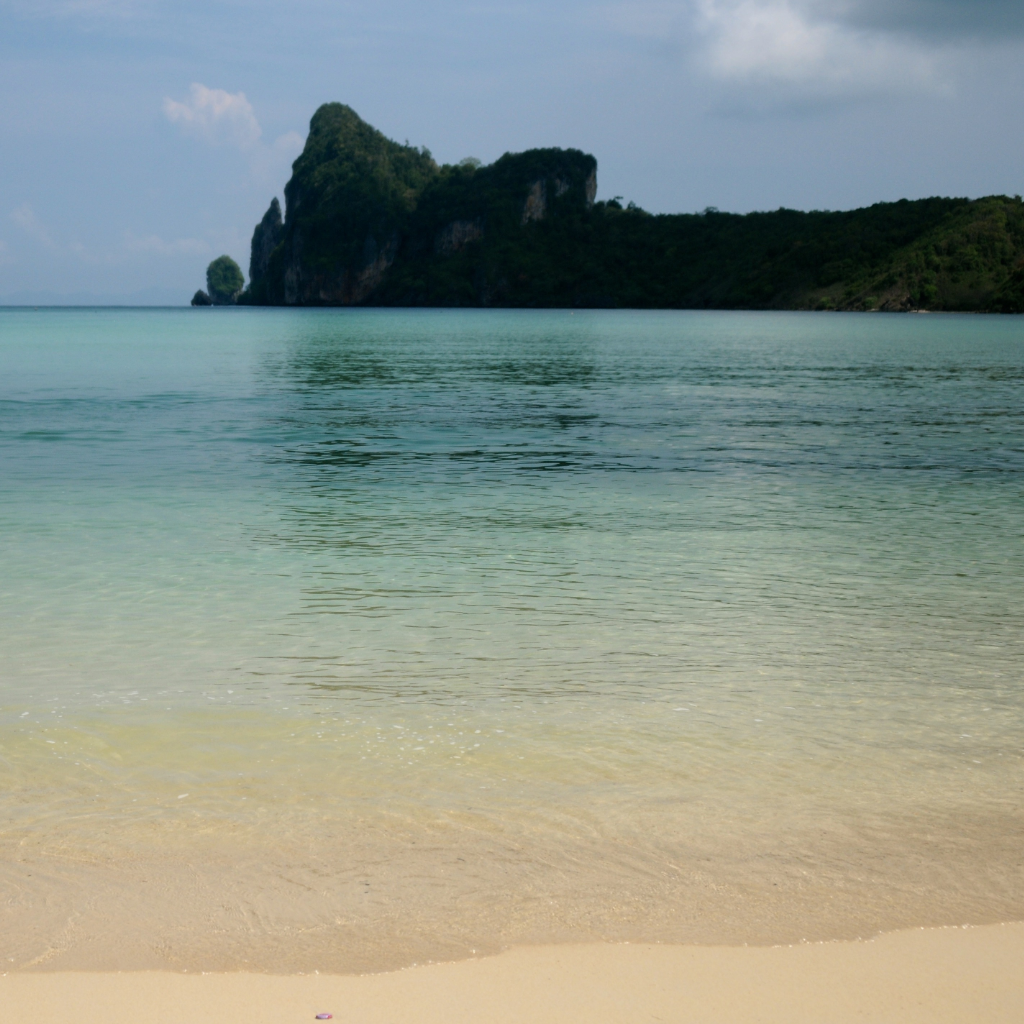
Our eyes genuinely didn't believe what they were seeing. A perfect cove with water in a shade of turquoise that I would have dismissed as photoshopped if I hadn't been standing in front of it. Completely real. The kind of beautiful that makes you stop mid-sentence and just point. It is one of the most beautiful places on earth and I mean that as factual statement rather than travel hyperbole.
We had massaman curry on the beach, a couple of beers, and then met our sleep-aboard boat for the overnight Maya Bay tour I had booked through TripAdvisor, which had excellent reviews. The boat was... smaller than advertised. Less spacious than the website implied. The "showers" turned out to be a bidet hose in a bathroom with a door that barely closed. The "covered sleeping area" for rain was optimistic given the number of people aboard.
We stuck it out through the snorkeling (the water was beautiful, the snorkeling itself less impressive than Florida, which surprised us) and then arrived at Maya Bay around 4:30pm. And this is when we conducted an honest self-assessment. We looked around at the crowd: almost entirely backpackers in their early twenties, trading multi-country stories, gearing up for a beach night of drinking and sleeping upright on a boat. We are wonderful people who support those experiences wholeheartedly for the people who want them. We are simply not those people. We are people who need a door that closes.
We bailed. We caught the night plankton dive back to shore instead, which turned out to be genuinely magical: plankton are tiny squid that light up when disturbed, so moving your hands and feet around in the dark water creates these little explosions of bioluminescence all around you. Way cool. Matt also discovered that the chest area of my swimsuit created the same effect when tapped, which he found very amusing and which is how I ended up with dying baby squid in my bra. I'm choosing to see this as a unique travel memory.
We found a cheap hotel, showered, and crashed. The next day we rented beach chairs for eight dollars and spent it swimming in and out of that unreal turquoise water. I would do that whole imperfect trip again for another day on that beach.
The James Bond Island tour the following day was everything the overnight was not: perfectly organized, well-staffed, and genuinely wonderful from start to finish. Our company was Two Sea Tour, and our guide Philipe had clearly been doing this a long time and loved it. He gave our group a two-hour head start on every other tour to get into the cave lagoons before the tide made it impossible.
The Phang Nga Bay itself is 42 islands, all limestone, rising out of the water in those dramatic jagged peaks. Approaching them by boat reminded us immediately of Guilin in China, the same kind of impossible-looking vertical rock formations covered in green. Except forty degrees warmer.
The cave lagoon experience was one of the most serene things I've done anywhere. We canoed into Diamond Cave, named for a rock inside that sparkled under the headlamps of our guides. Just a handful of canoes in complete quiet. Mangrove trees, a monitor lizard, a giant jellyfish, walking fish that skip along the surface and can survive out of water for two hours. We took a moment to stop paddling entirely and just listen. Then the tide started rising and by the time we were leaving, Matt and I had to lie completely flat in the canoe with my legs on top of his shoulders just to fit back through the cave opening. An adventure in every sense.
James Bond Island is where they filmed a scene from The Man with the Golden Gun in 1974 and has not been quiet since. More than 10,000 visitors a day. The rock itself is smaller than you'd expect but genuinely beautiful, and Philipe armed all the guides with props including a gold-painted toy gun for photos. He was very proud that no other tour company had copied this idea yet. We took the most ridiculous photos. We loved every second.
The tour ended on a private beach with warm sand that produced bubbles when you walked on it, like your own personal foot spa. Lunch was a full buffet on the boat. We couldn't have recommended Two Sea Tour more enthusiastically.
Our last night back in Phuket, we returned to the Thai restaurant at the resort and ordered two whole lobsters and banana fritters for dessert. Then packed. Then Cambodia.
The Country That Keeps Calling Us Back
Thailand | Phuket | April 2014 + March 2015 (+ 2 additional visits noted)
We have now been to Phuket four times. Four. That's not a number we've hit anywhere else on earth, and we've been to 31 countries. That's worth explaining.
It started in April 2014 with what were, at the time, the longest flights we'd ever taken to a destination: 13.5 hours to Beijing, a 2-hour layover, then another 6.5 hours to Phuket. Our flight had this feature on the seat display that showed the globe view of your route, which confirmed we were literally flying over the top of the Arctic Circle and halfway around the planet. The 3-minute Mandarin announcement followed by the 30-second English translation ("Ladies and gentlemen, the choice is beef and rice or chicken and rice") strongly implied we were missing something from those other two and a half minutes. We accepted the mystery and flew on.
We arrived in Phuket at 1:30 in the morning, cleared the enormous immigration line, and made it to the JW Marriott Mai Khao by 3:15am. They had fresh juice waiting and told us our room would be ready in an hour, which on no sleep after 22 hours of travel felt like the kindest thing anyone had ever said to us. We chose to wander the dimly lit resort grounds rather than sit in the business center, which was already the right decision. By the time we finally got into the room it was 5am. I set an alarm for 9am. We woke up at 10:20.
And that first morning on the beach told us everything we needed to know. The Indian Ocean is warm in a way that feels almost intentional, like it specifically decided to be welcoming. The waves are substantial and will absolutely take you off your feet if you don't pay attention, but once you figure out the bobbing technique you're completely fine. We ate Thai noodles for breakfast at the hotel and decided immediately that this was exactly the right choice, both the noodles and the destination.
Phuket has a quality that's hard to name but easy to feel. The pace of it. The people, who are warm without performing warmth, genuinely kind in a way that feels effortless. The food is extraordinary at every price point, from the resort restaurant to the roadside shack where the woman who owns it comes out speaking no English just to check if you're okay and you realize in that moment that "amazing" is the word you wish you knew in Thai. The beach. The way the whole place conspires to make you stop rushing. You understand very quickly why people return.
Matt's birthday dinner on that first trip was at the resort's Thai restaurant and set the bar for every Thai meal that followed. He ordered a crispy fried lobster in spicy chili sauce that was nothing like the cold-water lobster we know back home. Tender in a completely different way, with heat and brightness in the sauce that made the whole thing sing. I had a BBQ sea bass with turmeric and lemongrass that was beautiful. Dessert was mango sticky rice and banana fritters, both exceptional. Three waitresses balanced a birthday candle on the mango sticky rice and sang an extra verse of Happy Birthday, which meant Matt got his birthday embarrassment halfway around the world. Some things are universal.
We drove ourselves around on day two of the 2014 trip because Matt is legitimately fearless about driving in foreign countries (he once navigated a manual transmission out of Paris in heavy traffic, so Thailand's left-side driving was practically relaxing by comparison). We got completely lost trying to find what were supposedly major tourist attractions because nothing is well-signed and Apple Maps had opinions that turned out to be wrong. We drove down endless unmarked roads and doubled back more times than I'd like to admit, and we found everything eventually. The Buddhist temple Wat Bang Riang required me to purchase a cover-up top and pants for about three dollars because I hadn't thought ahead about dress code. Adding any layer of clothing in 90 degrees with 100% humidity is the kind of experience that makes you momentarily reconsider your life choices, but the temple was worth every sweaty second of it.
Lunch that day was at a roadside restaurant where we were the only non-Thais and where the food was home-cooked and extraordinary and cost nine dollars for two people including four beers. Nine dollars. The owner came out and just wanted to know if we were okay. We were more than okay. We were completely, ecstatically happy.
The monkey cave at Wat Tham Suwan Khuha was another navigational triumph, found eventually via a kilometer marker from a travel blog when Google Maps had given up on us. Hundreds of monkeys, which are simultaneously fascinating and make you feel like they're about to leap directly at your face. They don't. They just follow you, climb everywhere, and watch you with the particular intensity of an animal that has decided you're mildly interesting.
By the time we found a row of beachside shack restaurants on the drive home and Matt whipped the car over, we were ready for exactly what they served: whole fried fish, sand crabs, cold Chang beer, and a thunderstorm rolling in off the ocean while we sat in our little hut on the beach. This became our place. We went back multiple times. There is no better meal in the world than a whole fried fish on a beach in Thailand during a warm tropical storm when you have nowhere to be.
One year later we were back. The Marriott Beach Club this time, a sister property minutes from the JW, and Singapore Airlines, which has become our definitive favorite carrier for long haul travel. We arrived at 9am instead of 1am, cleared immigration in what felt like minutes, and had our room ready in twenty. I proudly said hello and thank you in Thai to the front desk staff, which I'd practiced. We took a small nap and walked along the beach to a local restaurant tucked between the resorts, ordered fried fish with three sauces, papaya salad, and Tom Ga soup, and sat looking at the Indian Ocean with a cold Chang in hand and felt the exact specific feeling of returning somewhere you love.
Something I want to say about Phuket and Thailand more broadly: everyone is happy here. That sounds simple and it isn't. You look around the pool or the beach and people are smiling, dancing, hugging, just thoroughly enjoying themselves. It's a genuinely diverse crowd, with Americans actually being the minority, which Matt and I both appreciate in a way that's hard to explain without sounding like we're apologizing for our countrymen. We're not. We just really enjoy being surrounded by families from all over the world. It brings a different energy than a Florida beach resort where, as Matt would say, we are there in droves.
Also the women here wear whatever they want on the beach, in every shape and age, with complete and total confidence. I find this deeply inspiring every single time. Matt suspects the rest of the world simply doesn't manufacture one-piece swimsuits. I think both things can be true.
We've returned twice more since 2015. Each time the pull is the same: the food, the people, the pace, the ocean that is the right temperature at the right time of year, and the sense that Thailand somehow resets something in us that the rest of life winds too tight. Four trips and we are not done. Not even close.