Africa | Europe | Middle East | South Asia | China | Latin America | Nordic
Angkors Away: Three Days Inside the Greatest Temple Complex on Earth
Cambodia + Bangkok | Siem Reap + Bangkok layover | May 2014
We'd seen Angkor Wat in the background of every travel poster and magazine for years before we actually went. You become almost numb to an image when you see it that many times. And then you turn a corner in a taxi from the Siem Reap airport and catch your first actual glimpse of it in the distance, and all that familiarity evaporates completely. We were giddy. Genuinely, unabashedly giddy.
Our hotel, the Pavilion D'Orient, came with something I want to specifically recommend to anyone planning this trip: a dedicated tuk tuk driver for the duration of the stay. Ours was named Poev, and he was a person of enormous smiles and endless patience. A tuk tuk is a four-seat cart attached to a motorbike, and it is the perfect way to move around Siem Reap: open to the air, immediate natural air conditioning at any speed, and completely capable of navigating roads that would challenge larger vehicles. It also just screams Cambodia in the best way.
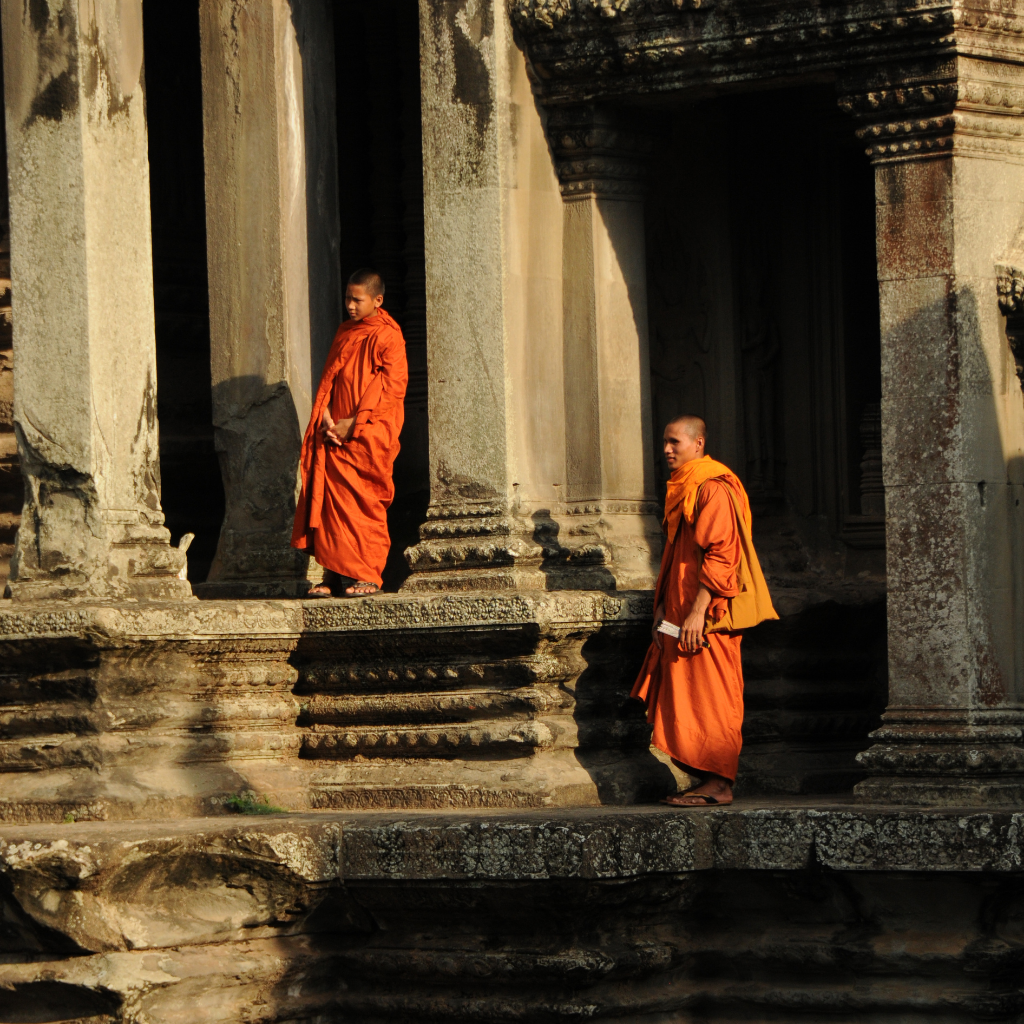
Angkor Wat itself. The largest religious monument in the world, built in the early 12th century, best preserved of all the temples in the complex and the only one that has remained an active religious site since it was built. Most people know it from the movie Tomb Raider (we rewatched it right before coming, obviously). What no movie quite captures is the scale, and what photographs miss entirely is the density of the carving. Every surface. Every wall, every column, every inch. Reliefs of mythological scenes, battles, daily life, all rendered with a level of detail that makes you stop and lean in again and again.
The temples are not close together, which we figured out by attempting to walk between Angkor Wat and Angkor Thom and realizing after some time that our map was not to scale. Poev collected us without complaint and drove us over.
Angkor Thom's south gate entrance is approached across a moat lined on both sides by rows of figures carrying the body of a giant serpent in what looks almost like a tug of war. The Bayon temple inside is famous for its towers, most of them carved with four enormous faces on each cardinal point. Hundreds of faces looking serenely in every direction. Standing inside it in the late afternoon light was one of the stranger and more beautiful experiences of the trip.
We did the 5am sunrise visit the second morning because Matt wanted to try for photographs and honestly because I can't remember the last time I actually watched the sun rise. I mean sat and watched from the first grey light through the moment it clears the horizon. We should all do this more. We don't.
Being up early also meant we got to Ta Prohm before most of the crowds. Ta Prohm is the temple where the massive Banyan tree roots have grown over and through the ruins over centuries, and it is remarkable. Also famously in Tomb Raider. We are Tomb Raider pilgrims apparently. The trees have essentially become structural elements now, holding up walls and archways through sheer biological persistence. It was one of our favorite sights of the whole trip.
The temples require real physical commitment in the heat. You're climbing uneven stone stairs, scrambling across ancient formations, navigating passages that weren't necessarily designed with modern tourists in mind. In that way it felt exactly like Machu Picchu, this combination of sightseeing and genuine physical adventure that makes you feel like an explorer rather than a visitor.
Banteay Srei was a 27-kilometer tuk tuk ride outside Siem Reap that was absolutely worth it. Built in the 10th century, older than Angkor Wat, dedicated to the Hindu god Shiva, and called the Citadel of Beauty. It earns the name. Where Angkor Wat is immense, Banteay Srei is intimate: smaller in scale but covered in some of the finest stone carving we saw anywhere. The pink sandstone it's built from gives it a different quality in the light. Get there early, go.
Banteay Srei also had the luxury of a visitor center with actual flush toilets, which deserves special recognition because the bathroom situation at Angkor is essentially two toilets for the entire complex and most of them involve a bucket of water and a pot for manual flushing. You calibrate accordingly and develop a certain philosophical acceptance of the whole situation.
On the way back we stopped at the Cambodian Land Mine Museum, which was a genuine gut punch. There are estimated to be more than three million unexploded land mines remaining in Cambodia. The museum is in front of a complex that houses and educates children who are victims, whether through injury or orphanhood. We had seen bands of blind and disabled musicians near the temples raising money for victims throughout the trip. Understanding the scope of the problem at the museum made those encounters land much harder.
The streets between the hotels and the temples were full of things to see and adjust to: motorbikes everywhere with entire families aboard and nobody wearing helmets; gas sold in old liquor bottles and soda bottles at roadside stands; children as young as three or four selling souvenir magnets with their learned English phrase of "two for one dollar?" because school is not an option for every child here. You see these things and you feel them. They don't become background noise. Every time we travel to a place like this, the same thing happens: I feel grateful in a way that stays with me long after I've come home.
Pub Street in Siem Reap is where the tourist nightlife concentrates, two car-free streets packed with restaurants, bars, massage places, and vendors who will follow you half a block saying "Lady, look, free to look, you want scarf?" Draft beer was fifty cents. Our full dinner for two, stuffed and with drinks, came to $14.50. We ate pomelo salad with prawns that was genuinely excellent, chicken with hot basil, fried spring rolls, pork fried rice. Matt wandered around photographing vendors selling insects to eat while I got a foot massage for two dollars for thirty minutes. We had the Tuk Tuk back to the hotel at 9:30pm and crashed immediately.
Matt also made a very thorough investigation of the Durian fruit situation. Durian, if you've never encountered it, has spikes on the outside and a flesh inside that has been described as smelling of rotten onions, turpentine, and raw sewage. They ban it from hotels and public transportation across Southeast Asia. Matt finds the smell appealing. I find Matt's affinity for Durian to be one of the more perplexing things about being married to him. We are otherwise very compatible.
What Cambodia does, what it has in common with China and Egypt and Jordan and Peru, is turn every one of your senses to maximum simultaneously. There are sights and sounds and smells and tastes and physical sensations all happening at once, all of them new, all of them demanding your attention. It wakes your brain up. It challenges you past points you thought were your limits. It makes you feel more alive than almost any other experience I know. That is why we travel. Not just to see things, but to feel fully, completely present in a world that is so much bigger and more varied than any one life can contain.
We flew to Bangkok with a layover before our long flight home, and even our single half-day there managed to be memorable. A tour counter at the airport offered us a custom driver for just over a hundred dollars, which we jumped on. Our driver was an older man with the longest hairs I have ever seen growing from a mole on his chin, approximately ten inches in length, and a laugh that punctuated every single thing he said. He reminded us both immediately of Victor Wong in The Golden Child. "Give me the knife!" He was wonderful.
He drove us past the Parliament Building, the Royal Palace (already closed but lit up beautifully), and then to Wat Pho, home of the Reclining Buddha. Nobody tells you how big the Reclining Buddha actually is. Huge doesn't cover it. Magnificent doesn't quite cover it either. You stand there looking at this golden figure stretching across the entire length of an enormous hall and you genuinely cannot process the scale of it. We also got to sit in on a live Buddhist ceremony for a while, which was quiet and rhythmic and unexpectedly moving.
Dinner was at a restaurant on the water called "In Love," which is a funny name for a restaurant but produced a lovely final meal: cold beer with ice (a habit we'd fully adopted by this point), live Thai music, and a view of the river at night. Then back to the airport. Then 22 hours of flying home with heads full of everything we'd seen.