Africa | Europe | Middle East | South Asia | China | Latin America | Nordic
Pig Nipples, Paella, and Gaudi's Light: Barcelona Did Not Hold Back
BARCELONA | October 2024
Our flight landed in Barcelona at 1pm. We were at the hotel by 3pm. By the time we went to sleep that night we'd logged over 15,000 steps, eaten tapas twice, done an evening food tour, and I had stopped feeling tired somewhere around the third plate of food. Barcelona has a way of overriding jet lag through sheer enthusiasm.
We hit the ground running and the city met us immediately.
The evening food tour was the right call for a first night. It's how we like to orient ourselves in a new food city: let someone who knows the neighborhood walk you through it, stop you at the right places, explain what you're eating and why it matters here specifically. Barcelona's tapas culture has its own logic and rhythm, and a good tour lets you feel it instead of reading about it.
The second day was the kind of day that reminds you why you travel. We started late, which felt right, and went straight to a tapas spot we'd had our eye on.
Three dishes. All of them excellent. Bone marrow with miso, which sounds like the kind of thing a chef puts on a menu to prove a point and then turns out to actually be the point: the richness of the marrow meeting the umami depth of miso in a way that makes both things better. Skirt steak with chimichurri, which is not a Spanish combination but was executed perfectly and I have no complaints. And pig trotter with grilled prawns, which is surf and turf reconsidered from a more interesting angle entirely.
Then the Sagrada Familia.
I want to be honest here, because honesty is sort of the whole point of how we travel: Gaudi's architecture is not instinctively our aesthetic on the outside. The exterior of the Sagrada Familia is extraordinary in its ambition and its scale and the sheer audacity of the thing, but it doesn't pull at me the way Gothic cathedrals do. I wanted to be fair to it before writing it off.
The inside changed everything.
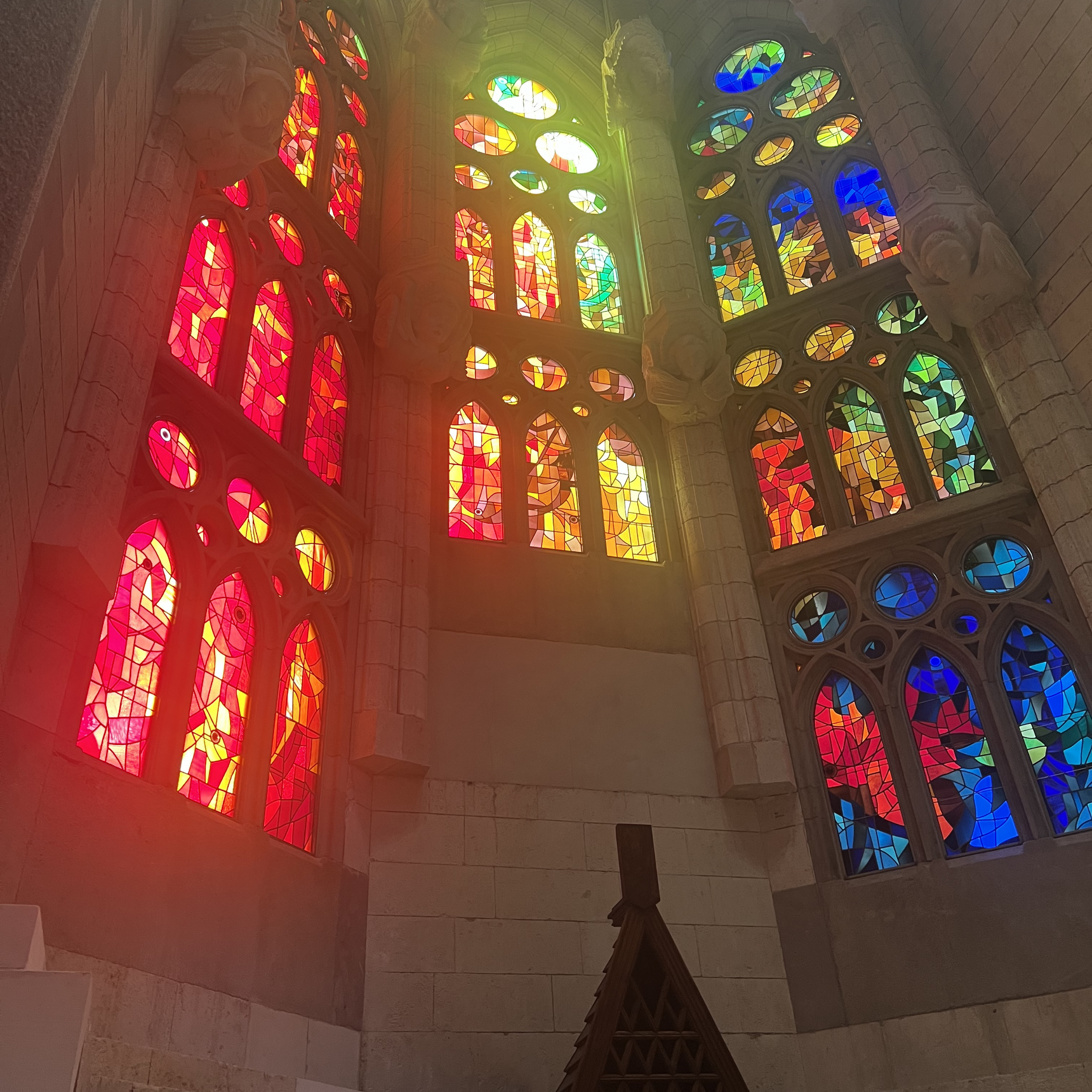
Gaudi designed the windows and the interior with obsessive attention to how light would move through the space at different times of day. The columns branch upward like trees reaching toward a canopy. The stained glass isn't decorative, it's structural to the whole experience: warm amber and gold on one side, cool blues and greens on the other, the whole interior shifting as the sun moves. Standing inside that building in the afternoon light is genuinely one of the most beautiful things I've experienced in a church, and I've been in a lot of churches.
We came out, found fresh churros with chocolate, and stood on the street eating them. Sometimes the sequence of things on a travel day is perfect and you notice it in the moment.
We walked back to the hotel stopping at food spots along the way. And I got my paella for the trip, which had been the goal since we booked flights.
One of our Barcelona days was taken over by thunderstorms, which sounds like a problem and turned out to be an opportunity. When the weather won't let you walk the city you go inside, and going inside in Barcelona means eating and drinking somewhere good.
We found a cocktail bar that shows up on a lot of 'best of Barcelona' lists, which can go either way: sometimes lists exist to validate what's genuinely excellent and sometimes they exist to send tourists somewhere that used to be good. This one was the former.
Dinner was at Dos Pebrots, which is an Anthony Bourdain restaurant in the sense that he ate there and talked about it the way he talked about places that genuinely got him. We'd noted it specifically because of Bourdain's recommendation and made a point of going.
The tasting menu was very, very good. But I need to tell you about the pig nipples.
Yes. Pig nipples. On the menu. Braised in an Iberico ham jus and presented in a way that, as I noted at the time, was worth it for the presentation alone before you even got to the eating. Matt was in full pig heaven. I watched him have what I can only describe as a spiritual experience with this dish.
This is why Anthony Bourdain's recommendations hold up. He never told you where to go for the safest, most comfortable version of a cuisine. He told you where to go for the most honest one.
Our last Barcelona day brought more rain, which we were not going to let stop us from getting to Montserrat. We took a train out of the city, then a tram, then a cable car up the mountain, which is exactly the kind of multi-modal journey that makes you feel like the destination earned you as much as you earned it.
Montserrat is a Benedictine monastery built into a series of dramatic rocky peaks about an hour outside Barcelona. It's been there, in various forms, since the 9th century. Napoleon raided it in the early 1800s and took most of what was worth taking. What he couldn't take, or perhaps didn't bother with, was the Black Madonna, the carved wooden statue of the Virgin Mary that sits in the basilica and has been there since the 12th century. She's the one thing that stayed.
There's something about a place that has been continuously inhabited and continuously meaningful to people for over a thousand years. You feel the age of it differently than you feel the age of a ruin. A ruin has stopped. Montserrat hasn't.
We got back to the city fairly late, had another good dinner, and the next morning loaded up for the six-hour drive south to Cartagena.