Africa | Europe | Middle East | South Asia | China | Latin America | Nordic
Who Gets a Private Charter on Spanish Waters? We Do. (Sort Of.)
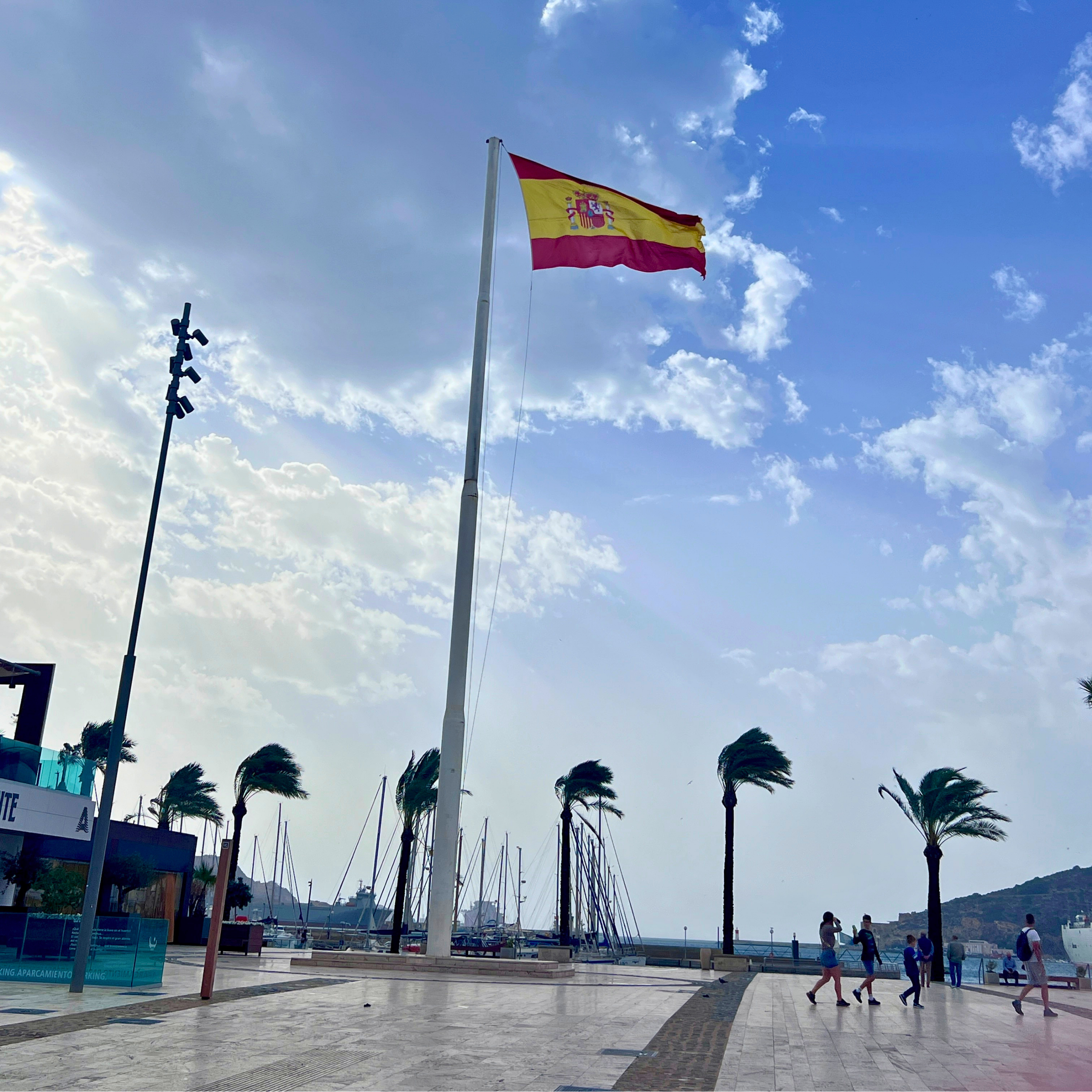
Cartagena
The drive from Barcelona to Cartagena takes about six hours in good conditions, and we had beautiful calm weather for it. The landscape changes significantly as you move south along the coast: the lush green of Catalonia gives way to something more arid and sun-baked, the Mediterranean light shifting toward that particular quality it has in the south of Spain where everything seems to be happening at a slightly warmer frequency.
We were going to see Marianne and Mitch.Marianne is Matt's aunt. She and her husband Mitch live on their sailboat in Cartagena. Not 'they have a sailboat they keep in Cartagena.' They live on it. Full time. In the Mediterranean.
I want to sit with that for a moment because it represents a life decision of a particular boldness that I find genuinely inspiring every time I think about it.
Their boat is home. Cartagena is their port. And when Matt and I came to visit, they showed us exactly how they spend their days in this city that sits on the southeastern tip of Spain, with Roman ruins in the city center and the sea right there and no commute except the one from below deck to above.
Day one in Cartagena: Matt got to drive Little Red.
Little Red is their Renault 4, an older model in that particular shade of red that old French economy cars come in, small and cheerful and utterly at home on narrow Spanish coastal roads. Matt drove it to a local beach with Zorro, Marianne and Mitch's dog, riding along as co-captain. I'm told Zorro took his duties very seriously.
We drove to La Azohía, a small fishing village about 35 minutes from Cartagena, for lunch. Seafood, paella, the Mediterranean in front of us. This is the kind of meal that doesn't require a lot of description because the setting does most of the work: fresh fish in a place where the boats that caught it are visible from your table, wine that costs less than you expect and tastes better than you'd predict, nobody in a hurry.
Back in Cartagena, Matt and I visited the ancient Roman Theater. Cartagena was a major Roman city, one of the most important in Hispania, and the theater dates to the 1st century BC. It was buried for centuries and only excavated starting in the 1980s, which means it's extraordinarily well preserved in places, the stone seating tiers still intact, the stage area recognizable as what it was.
Dinner in the seaside town that evening. Cartagena has that quality of being genuinely lived-in rather than tourist-configured, which you feel most clearly at dinner when the restaurants are full of people who live there.
The next day, Marianne and Mitch took us sailing.
The Mediterranean was not cooperative. The seas were rough and choppy in a way that made anchoring for lunch impossible, which had been the plan. Matt did not do well on the rough water. This is a diplomatic way of saying that my husband spent a significant portion of our private sailing charter on the Mediterranean feeling genuinely unwell, which he powered through with more commitment than I would have managed.
Here is what I want you to understand about Marianne: she is on a boat that is actively pitching in rough seas, the anchoring plan has been abandoned, and she decided to cook anyway. On a Swiss stovetop oven she keeps on board. A deep dish pizza. From scratch, essentially, on a moving vessel in choppy water on the Mediterranean Sea.
It was delicious. She is extraordinary. Matt was grateful and also slightly green.
Who gets a private charter on Spanish waters? We do. It's not something I'll ever take for granted.
The trip ended with a sunrise in Tarragona, the ancient Roman city on the Catalan coast north of Barcelona. It was our last morning in Spain before the flight home that evening.
There's a particular quality to the last morning of a trip. Everything is already slightly past tense: you're watching something you're already beginning to remember rather than fully inhabit. A good sunrise helps. The Spanish coast at first light is an excellent last image to carry home.
A long, great week. That's what your post said, and it was exactly right. Long in the best sense: full, layered, varied, the kind of trip that takes a few days at home before you've fully processed everything that happened.
Spain, we'll be back.
Pig Nipples, Paella, and Gaudi's Light: Barcelona Did Not Hold Back
BARCELONA | October 2024
Our flight landed in Barcelona at 1pm. We were at the hotel by 3pm. By the time we went to sleep that night we'd logged over 15,000 steps, eaten tapas twice, done an evening food tour, and I had stopped feeling tired somewhere around the third plate of food. Barcelona has a way of overriding jet lag through sheer enthusiasm.
We hit the ground running and the city met us immediately.
The evening food tour was the right call for a first night. It's how we like to orient ourselves in a new food city: let someone who knows the neighborhood walk you through it, stop you at the right places, explain what you're eating and why it matters here specifically. Barcelona's tapas culture has its own logic and rhythm, and a good tour lets you feel it instead of reading about it.
The second day was the kind of day that reminds you why you travel. We started late, which felt right, and went straight to a tapas spot we'd had our eye on.
Three dishes. All of them excellent. Bone marrow with miso, which sounds like the kind of thing a chef puts on a menu to prove a point and then turns out to actually be the point: the richness of the marrow meeting the umami depth of miso in a way that makes both things better. Skirt steak with chimichurri, which is not a Spanish combination but was executed perfectly and I have no complaints. And pig trotter with grilled prawns, which is surf and turf reconsidered from a more interesting angle entirely.
Then the Sagrada Familia.
I want to be honest here, because honesty is sort of the whole point of how we travel: Gaudi's architecture is not instinctively our aesthetic on the outside. The exterior of the Sagrada Familia is extraordinary in its ambition and its scale and the sheer audacity of the thing, but it doesn't pull at me the way Gothic cathedrals do. I wanted to be fair to it before writing it off.
The inside changed everything.
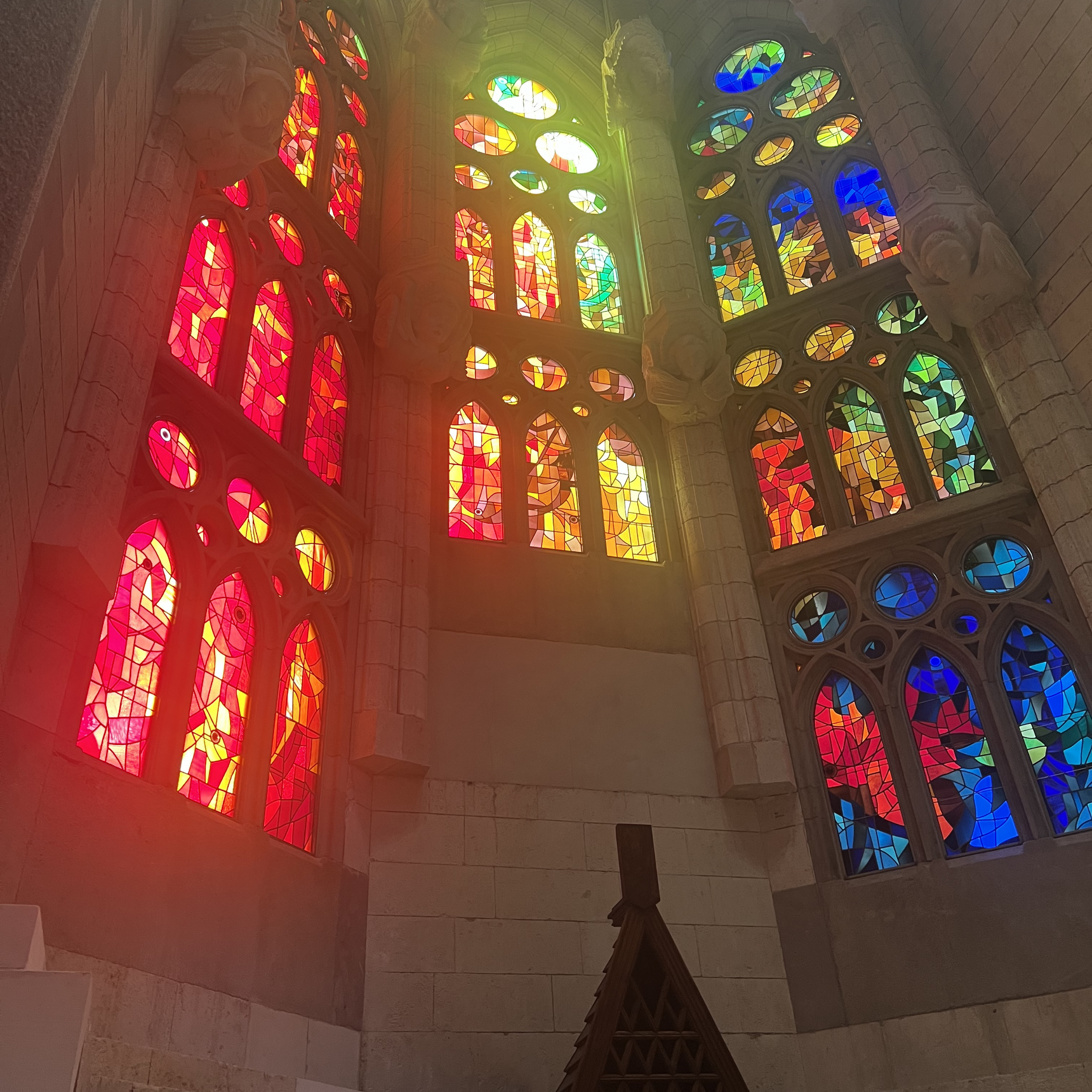
Gaudi designed the windows and the interior with obsessive attention to how light would move through the space at different times of day. The columns branch upward like trees reaching toward a canopy. The stained glass isn't decorative, it's structural to the whole experience: warm amber and gold on one side, cool blues and greens on the other, the whole interior shifting as the sun moves. Standing inside that building in the afternoon light is genuinely one of the most beautiful things I've experienced in a church, and I've been in a lot of churches.
We came out, found fresh churros with chocolate, and stood on the street eating them. Sometimes the sequence of things on a travel day is perfect and you notice it in the moment.
We walked back to the hotel stopping at food spots along the way. And I got my paella for the trip, which had been the goal since we booked flights.
One of our Barcelona days was taken over by thunderstorms, which sounds like a problem and turned out to be an opportunity. When the weather won't let you walk the city you go inside, and going inside in Barcelona means eating and drinking somewhere good.
We found a cocktail bar that shows up on a lot of 'best of Barcelona' lists, which can go either way: sometimes lists exist to validate what's genuinely excellent and sometimes they exist to send tourists somewhere that used to be good. This one was the former.
Dinner was at Dos Pebrots, which is an Anthony Bourdain restaurant in the sense that he ate there and talked about it the way he talked about places that genuinely got him. We'd noted it specifically because of Bourdain's recommendation and made a point of going.
The tasting menu was very, very good. But I need to tell you about the pig nipples.
Yes. Pig nipples. On the menu. Braised in an Iberico ham jus and presented in a way that, as I noted at the time, was worth it for the presentation alone before you even got to the eating. Matt was in full pig heaven. I watched him have what I can only describe as a spiritual experience with this dish.
This is why Anthony Bourdain's recommendations hold up. He never told you where to go for the safest, most comfortable version of a cuisine. He told you where to go for the most honest one.
Our last Barcelona day brought more rain, which we were not going to let stop us from getting to Montserrat. We took a train out of the city, then a tram, then a cable car up the mountain, which is exactly the kind of multi-modal journey that makes you feel like the destination earned you as much as you earned it.
Montserrat is a Benedictine monastery built into a series of dramatic rocky peaks about an hour outside Barcelona. It's been there, in various forms, since the 9th century. Napoleon raided it in the early 1800s and took most of what was worth taking. What he couldn't take, or perhaps didn't bother with, was the Black Madonna, the carved wooden statue of the Virgin Mary that sits in the basilica and has been there since the 12th century. She's the one thing that stayed.
There's something about a place that has been continuously inhabited and continuously meaningful to people for over a thousand years. You feel the age of it differently than you feel the age of a ruin. A ruin has stopped. Montserrat hasn't.
We got back to the city fairly late, had another good dinner, and the next morning loaded up for the six-hour drive south to Cartagena.
This Erin Is Finally in Erin: A Week Driving the Wrong Side of Irish Roads
The London Detour: Wizards, Windsor, and a Full English with Champagne
We flew into London first, which was not the most efficient routing decision but was absolutely the correct one. Two stops before Ireland. Both of them completely worth it.
Windsor Castle went first. We stored our luggage, found a full English breakfast with champagne, which is the right way to handle jet lag if you ask me, and then went to the castle. It exceeded our expectations, which given that it's Windsor Castle and we had fairly significant expectations, is saying something.
The highlight, without question, was Saint George's Chapel. No photographs allowed inside, which is the right call and also the kind of rule that forces you to actually look at things instead of photographing them. We paid our respects to the Queen and the Duke of Edinburgh, whose tombs are there now. We saw the tombs of monarchs going back centuries. There's something genuinely affecting about standing in a place where that much history has accumulated in one building.
Then: Full geek mode…Warner Bros. Studio, The Making of Harry Potter.
I need to disclose upfront that I knitted myself a Harry Potter sweater specifically for this visit. Channeled my inner Mrs. Weasley. No regrets.
I had been anticipating this for months and it still managed to blow past all of it. Ninety-nine percent of those films, over ten years of production, were filmed exclusively on those soundstages. The actual sets. The actual props. The actual costumes. You stand on the actual floor of the Great Hall and it is genuinely overwhelming to comprehend the scale of what was built and maintained and evolved over that decade.
But the best part wasn't any of that. It was the kids. Children in robes and round glasses, vibrating with excitement, seeing this world made real for the first time. A whole new generation of Potterheads who will keep this story alive for another twenty years. That got me more than anything else in the building.
This Erin Is Finally in Erin
My name is Erin. Ireland in Irish is Éire, and the anglicized version, Erin, is also a poetic name for the country itself. I have been aware my entire life that my name means Ireland and I had never been there.
We landed at Dublin, picked up a rental car, and began immediately navigating the left side of the road, which is its own adventure that I recommend to anyone who enjoys mild cardiovascular stress at roundabouts.
We headed straight from Dublin to the Rock of Cashel, a 12th-century castle complex sitting on top of a limestone outcropping in the middle of County Tipperary. There's no easing into it. You come around a bend and there it is, rising improbably from the flat Irish plain, and your brain has to recalibrate because it looks more like a set piece than a real place.
Lunch stop. Guinness attempt.
Still tasteless at this point. I know, I know. Every Irish person reading this is experiencing a physical reaction. But listen, there are genuinely more flavorful Irish stouts available in this country and Matt was committed to finding them. The Guinness investigation would continue throughout the week.
We stayed in Kilkenny and it charmed us completely. A medieval city with a proper castle, cobblestone streets, and the kind of atmosphere that makes you understand immediately why people actually choose to live somewhere versus just visit it.
On our second day, we covered a lot of ground and three completely distinct experiences, which is either excellent trip planning or the Irish countryside being very cooperative, probably both.
Midleton first, for a premier whiskey tasting at Jameson, who has been making Irish whiskey since the 1700s on this site. I always learn something at a distillery visit. How the barrels interact with the spirit over years, what the mashbill does to the flavor, why Irish whiskey tastes nothing like Scotch despite being made from largely the same raw ingredients. The Jameson tour is comprehensive and the tasting is the right length. We left knowing more than we arrived with.
Then Cobh, pronounced 'Cove,' the coastal town that was the Titanic's last port of call before the Atlantic. The White Star Lines building is still there, now housing a Titanic experience. We had lunch, which included some of the most excellent fish and chips.
We drove to Killarney, which would be our home base for a few days.
The Dingle Peninsula is not meant to be driven quickly. The roads in places are wide enough for exactly one car, which becomes interesting when another car appears heading in the opposite direction and someone has to negotiate a solution in real time. We did a full loop in the rain, which was misty and dramatic and honestly perfect.
What I didn't fully appreciate going in is how many scenes from the Star Wars sequel trilogy were filmed on this peninsula. The landscape has that quality to it, ancient and stark and slightly otherworldly, where you can completely understand why a filmmaker looked at it and decided it was where the last Jedi would go to disappear.
January in Ireland means you have a lot of places almost entirely to yourself, which is an underrated advantage. The roads and cliffs and ruins with no crowds, just the landscape and the weather doing their thing.
An Important Update on the Guinness Situation: Matt ordered a few. Things were progressing. We noted that each pub seemed to pour it slightly differently, which is either a real phenomenon or confirmation bias from two people determined to find a reason to keep ordering it. The investigation is officially ongoing…
Our fourth day was all about the The Ring of Kerry. A famous scenic drive around the Iveragh Peninsula and we did the whole thing, which takes most of a day and reveals more landscape variety than seems reasonable for one loop of road.
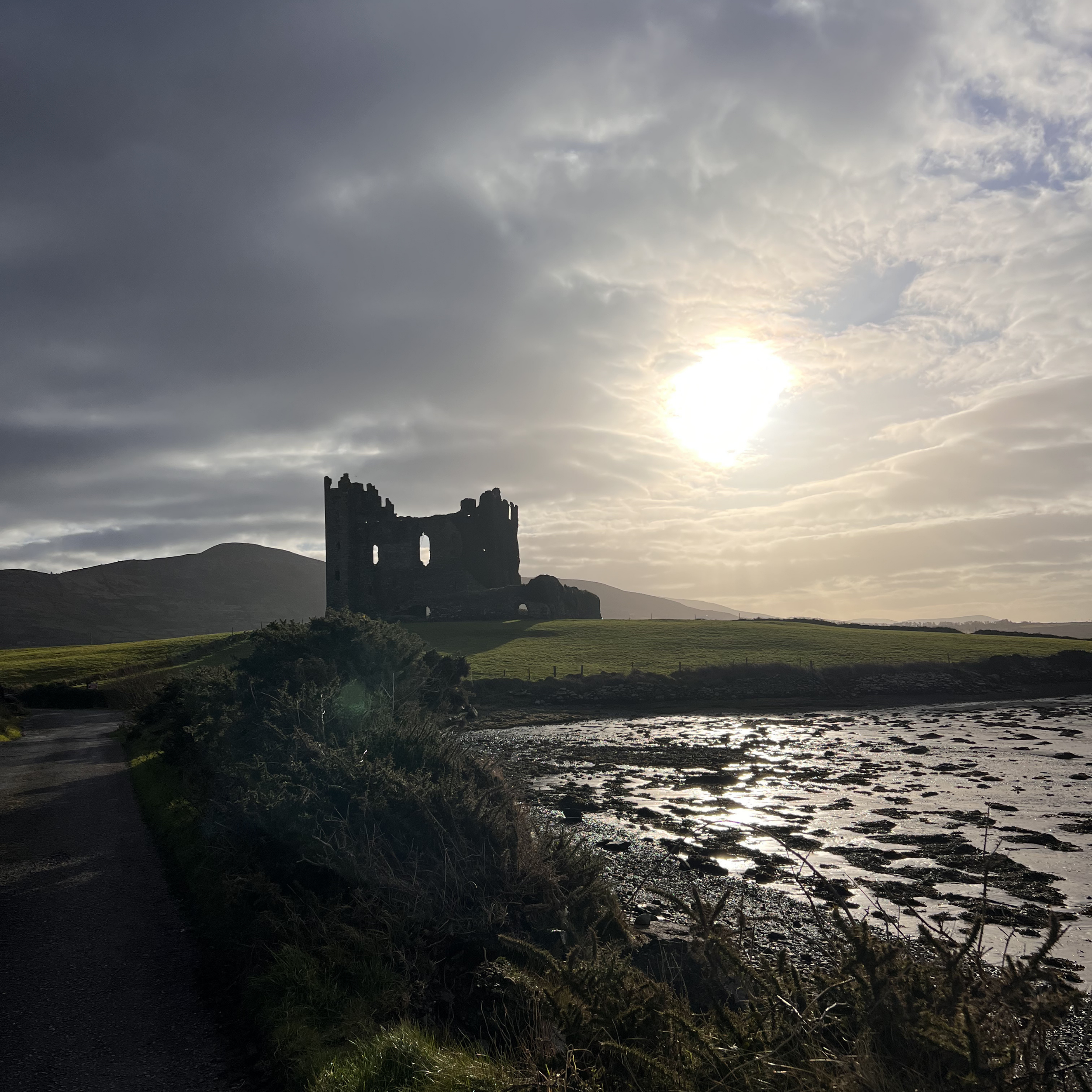
The first half is quintessential Ireland. Every cliché you have in your head about green rolling hills and dramatic coastline and stone walls that have been there since before anyone currently alive can remember. We stopped at the ruins of Ballycarbery Castle, which sits on a rise above Cahersiveen with the water behind it and has been a ruin since the 17th century, which still feels recent given what's around it.
Then Cahergall Stone Fort. Iron Age ring fort, remarkably intact, built sometime in the first millennium. You walk through the original entrance and stand inside the stone walls and try to comprehend that people built this by hand on this exact spot over a thousand years ago and it's still standing. Ireland has this quality throughout but Cahergall delivers it with particular force.
The second half of the Ring turns planetary. The landscape shifts and the green gives way to something more lunar, exposed and dramatic, the kind of terrain that makes you feel like you're looking at the edge of a world rather than the interior of one.
We ended the day at Killarney National Park. The Gap of Dunloe is a narrow mountain pass between the MacGillycuddy's Reeks and the Purple Mountain, and it's the kind of place where photographs look like they've been edited to be more dramatic than real life. Real life is fine. Real life there is extraordinary.
Muckross Abbey, roofless and ancient, with a yew tree in the center of the cloister that's believed to be 600 years old and looks exactly that old, gnarled and enormous and completely indifferent to everything that has happened around it since it was planted.
We stopped at the Celtic Whiskey Bar and Larder, which has 1,200 bottles of whisky and scotch. We were not prepared. We spent a significant amount of time here. This was not a complaint.
For dinner we went back to the same restaurant we'd eaten at the night before, because we'd both spent the entire previous meal watching each other's plate and wishing we'd ordered what the other person had. We fixed that. I recommend this approach.
Day 5, we took a car ferry from Kerry to Shannon, which is one of those travel logistics that sounds mundane and turns out to be its own quiet pleasure. The sea, the views, the transition from one Irish coast to another.
First stop in Shannon was the Kilkee Cliffs, and I want to record officially that we were the only people there. In January in Ireland, the tourist infrastructure is quiet and sometimes outright closed, but what you get in exchange is access to places of extraordinary beauty with no one else standing in front of you. The Kilkee Cliffs are magnificent. Genuinely, vertigo-inducing, stand-at-the-edge magnificent.
Finding an open restaurant for lunch in rural January Ireland was its own small victory that we celebrated accordingly.
Then the Cliffs of Moher, which are the famous ones, and the contrast with Kilkee was interesting. The Cliffs of Moher are everything you've seen in photos, genuinely breathtaking and everything you'd imagine, but they also had more visitors there than we'd seen anywhere else in Ireland the entire trip. After a week of having cliffs and castles largely to ourselves, it was a bit of an adjustment.
We stayed the night in Ennis, comfortable and relaxed, ready for the last day started with Kilbeggan Distillery, licensed in 1757, is the oldest licensed distillery in Ireland and possibly one of the most interesting few hours you can spend in the country if you have any interest at all in where whiskey comes from.
We did the tour and then we did the bottle-your-own experience, where you fill your own bottle from a 10-year-old Distiller's Cask that is only available at that location for that specific experience. I can tell you that there is something satisfying about filling a bottle with your own hands from a cask of whiskey that has been aging since before you decided to visit the country.
Dublin last. The city after a week in the countryside felt a bit overwhelming, honestly. We'd had Ireland largely to ourselves for seven days and Dublin was a reminder that the world has a lot of people in it.
Our taxi driver after dropping off our rental car saved us. We told him we wanted somewhere local, somewhere with traditional Irish folk music, somewhere that wasn't a tourist pub. He sent us exactly where we needed to go.
Almost everyone in that bar was singing along. Not performing, not watching a performance, just singing because the songs are ones they know and have always known and the music pulls it out of you. Traditions like that are easy to be sentimental about from the outside and entirely different to sit inside of. It was heartwarming in the most literal sense of the word.
Thank you Ireland. A week that felt twice as long in the best possible way, because it was so full. We drove the left side of your roads and ate your fish and chips and stood at the edge of your cliffs and drank your whiskey in your oldest distillery and then sat in a pub and listened to your people sing your songs.
This Erin was, finally, in Erin. Worth every year of waiting.
Rock Music, a Tiny Camper, and the Best Lunch in Brittany
France | Download Music Festival + Brittany road trip | June 2018
1- Twenty Years, One Ring Per Five: Our Anniversary on the French Riviera
Twenty Years
Twenty years of marriage is one of those milestones that sounds significant even before you start trying to describe what it actually means. It's not just time. It's the accumulated weight of every decision made together, every trip packed for, every dinner cooked, every inside joke that wouldn't make sense to anyone else on the planet.
We decided to celebrate in France (of course we did). It’s a country that changed us both, and we went all in: a road trip through the south, ending in Paris, two weeks total. We had a French rap playlist queued up before the wheels hit the tarmac. We landed, picked up our rental car and hit the open road…credit card at the ready for the million toll stops we knew were on the way.
Dijon: Grey Poupon and a Good Night
First stop was Dijon, overnight on our way south, and yes, we absolutely leaned into the Grey Poupon reference. We had to. The town itself is charming in that very French way where the architecture does most of the work and you just have to show up and walk around appreciating it. A nice meal, a comfortable night, and then south toward the Mediterranean.
We had a wonderful dinner dining on chicken with fresh morel mushrooms that was unbelievably perfect and then wandering through the small streets as the sun went down. It’s a town that we would return to anytime we have the possibility.
Cassis: The Winemaker, the Wine Bar, and the Ring
Cassis sits on the Mediterranean east of Marseille, and if you've never heard of it, that's honestly part of its charm. It's not famous the way Nice or Cannes is famous. It's just deeply, quietly beautiful, with turquoise water and limestone cliffs and a small harbor where fishing boats still go out in the morning.
We were there for two days, and Uncle Larry had done us an enormous favor by pointing us toward Clos Ste Magdeleine, a winery considered one of the most beautiful vineyards in the world. The family still lives in the main house on the property, so you can't wander the whole estate, but what you can see of it is extraordinary. The sea visible through the vines. The kind of view that makes you understand immediately why someone chose this exact piece of ground to plant something permanent.
The people were so lovely. They walked us to a spot with a view of the sea, unhurried and genuinely warm, the way small family wineries often are when they're not performing hospitality but just actually being hospitable.
Then there was the wine bar.
We found a spot in town where the owner was what I can only describe as unreservedly wonderful. He gave us free pours. He gave us hugs. Every time we came back, which was more than once, he treated us like people he'd known for years. That kind of spontaneous human warmth is exactly why we travel.
Cassis is just a wonderful, quitter seaside stop where you could laze away the days and just relax. An enjoyable stay to say the least.
Gordes: The Hilltop Town That Earns Every Cliché
We made a day trip to Gordes, which is one of those Provençal hilltop villages that shows up on every 'most beautiful villages in France' list and still manages to exceed the expectations that list creates. The town is built into the rock. The stone buildings rise out of the limestone as if they grew there organically rather than being placed by human hands. The light in the late afternoon does things I don't have adequate language for.
We drove into the heart of the town and popped in and out of shops, took pictures, and then found a wonderful little café with excellent meringues, cocktails, and a nice view to boot. The sun was out and it was a wonderful way to spend an afternoon.
Eze and the Château Eza: Our Splurge Moment
We made the short drive to Eze next, and I want to be careful about how I say this because I don't want to oversell it and I don't think I can undersell it: the view from Eze literally took my breath away when we arrived. I felt emotional. I wasn't expecting to feel emotional. But there it was.
Eze is a medieval village perched on a rocky peak above the Mediterranean, about 400 meters up, and from certain angles it looks like it shouldn't be physically possible that a village exists there. The sea below is that particular impossible shade of blue that the Mediterranean does in summer, and the whole picture is just too much to absorb at once.
Château Eza was our splurge hotel and room for this trip, and we committed to it completely. We sat in the on-deck jacuzzi with wine and champagne and looked out at the sea and tried very hard to absorb everything. We had a tasting menu for dinner that we watched unfold as the sun set over the Mediterranean.
I feel a wee bit like Lifestyles of the Rich and Famous showing up in a place like that, but I also feel like 20 years of marriage and a lifetime of traveling as real working people earns you an occasional jacuzzi above the Mediterranean. We earned it.
Monaco: Because It Was 20 Minutes Away
We had never thought seriously about visiting Monaco, but when you're in Eze and Monaco is literally 20 minutes down the coast, the question becomes less 'should we go' and more 'why wouldn't we.' So we went.
It is exactly what you think it is. Incomprehensible concentrations of wealth made very visible in the form of yachts and sports cars that cost more than most people's houses. The casino sits there like it knows exactly what it is. It's a genuinely strange place to spend a few hours and I'm glad we did it, but I don't think Monaco is on our 'can't wait to go back' list.
Vienne: The Perfect Last Night on the Road
Our last night of the road trip before Paris was in Vienne, about halfway between Eze and the capital. Matt found an apartment on a couple's property with a view of the city, which is exactly the kind of accommodation discovery that makes you feel like you're actually living somewhere rather than just passing through it.
Fruits de mer for dinner. Which is to say: a glorious, cold platter of everything the sea has to offer, with good bread and butter and wine, the way the French do it, leisurely and completely unpretentious about the fact that you're eating very well.
Then we were on our way back to our travel heart…Paris.
2 - A Padlock on the Louvre and Twenty Years in the City of Light
The First Thing I Do in Paris
The first thing I do when I arrive in Paris is light a candle for my Dad. Every time. It's not a complicated ritual or a formal one. It's just something I do because my father was the person who first brought me to Paris, 27 years ago now, and I've been coming back ever since. He gave me this city, he gave me the gift of seeing a world outside of the tiny bubble I grew up in, he gave me that feeling…the feeling that I need to leave my hometown, try new things, experience new cultures, in order to grow. Lighting a candle is the least I can do.
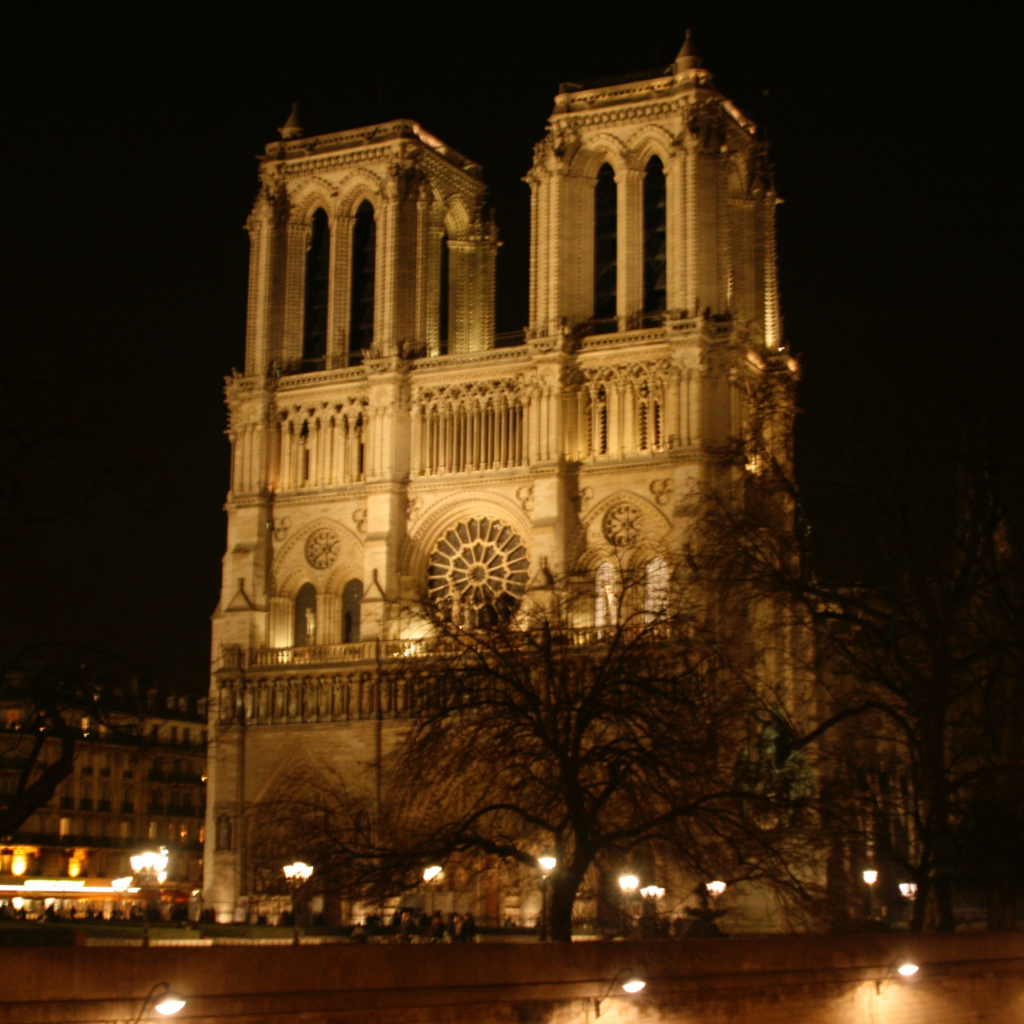
Notre Dame has always been where I do it.
Notre Dame is still under construction. It has been since the fire in 2019, and it will be for some time yet. The scaffolding surrounds it, the cathedral is closed to visitors, and if you're someone who has stood inside that building and felt what it does to you, the sight of it wrapped in construction equipment is its own particular kind of sadness.
I couldn't light my candle there. So I found Église Saint-Merry, just a short walk away in the Marais, and I lit it there instead.
I stood in the quiet of that church, lit the candle, and said thank you to my father for changing the course of my life by bringing me here the first time. Some moments on a trip are private ones. This was one of those.
Our Paris, Revisited
We stayed in an Airbnb with a rooftop view of Paris, which is the right way to arrive in a city you've been to before. Not a hotel lobby, not a view of an alley. A rooftop, with the city spread out around you, lit up in the evening in that particular golden way Paris manages even when it's being completely ordinary about it.
We walked to Notre Dame our first evening, not to go in (impossible) but to see it, to check in on it. The construction is jarring and also somehow moving, evidence of a place so important to so many people that the whole world decided collectively that it had to be brought back. We stumbled upon a great little restaurant know for its wood-fired rotisserie chicken and had a nice meal before coming “home” to the rooftop.
Tuesday: Wine, Cheese, and a Full Day of Favorites
We started Tuesday with a French wine class paired with regional cheeses, which is an activity I will recommend to anyone visiting Paris without qualification or hesitation. You learn things. You drink good wine at an hour that would seem unreasonable at home and seems completely reasonable in France. You eat cheese that reminds you why the French are the way they are about cheese. It's an excellent morning.
Then we walked. We always walk Paris. Les Invalides, with Napoleon's tomb in that enormous gold-domed cathedral that somehow manages to be less about hubris and more about genuine grandeur in person. The Eiffel Tower, which I know sounds like the obvious tourist thing and is the obvious tourist thing and is still worth doing every single time because it's the Eiffel Tower and it never stops being improbable.
Musée Rodin. If you haven't been, it's not what you expect. The sculptures are inside but the gardens are where Rodin really gets you, The Thinker sitting outdoors with the gardens spreading around it, Burghers of Calais in the open air. It's a museum you can actually breathe in.
Wednesday: The Unicorn Tapestries, Montmartre, and a Jazz Club
Wednesday was one of those Paris days that strings together so many good things it stops feeling real.
We went back to Musée de Cluny for the Unicorn Tapestries, which is one of our favorite things in the city. They're housed in their own dedicated room in the medieval museum, six tapestries depicting a unicorn and a noblewoman in an allegorical setting that art historians have been arguing about for centuries. The colors shouldn't still be that vivid after 500-plus years. They are. You walk into that room and something about it quiets you down immediately.
Then Montmartre. Up to Sacré-Coeur, which earns its reputation from the outside even if the inside is less remarkable, and over to Place du Tertre, where artists have been selling their work for decades. We ended up buying another painting. This has become something of a pattern when we visit Paris and I don't intend to stop.
We wandered St. Germain-des-Prés, more fruits de mer, and then, through whatever combination of instinct and luck that good travel days sometimes produce, we found a jazz club.
I don't mean we looked one up. I mean we turned a corner and there it was, warm light coming through the windows, music audible from outside, and we went in. Great music and a great dinner in the same room. Some of the best nights in Paris happen this way.
Thursday: Rain, the Louvre, and a Lock on a Bridge
Our last full day in Paris started rainy, which is fine. Paris in the rain is still Paris. We waited it out, and when it cleared late afternoon we headed to the Louvre courtyard, one of our favorite outdoor spots in the city.
Two musicians were playing. We stood and listened for a long time. I don't know who they were or what they played specifically. I know the light was good and the Louvre pyramid was doing its thing behind them and it was one of those unplanned perfect moments that Paris produces with annoying regularity.
Then we put a lock on a bridge for our twentieth anniversary.
The Pont des Arts doesn't do the Locks of Love anymore officially, the weight of all those padlocks was genuinely becoming a structural concern, but there are still places along the Seine where you can add yours, and we did. Twenty years. One lock. It felt right to do it in the city where we've returned more than any other, the city my father gave me, the city Matt and I have made our own over two decades of coming back.
We wandered until it was time to leave. That's the only way to end a Paris trip. No agenda, no final destination, just more streets and light and the particular feeling of a city you love that you're not quite ready to say goodbye to yet.
Au revoir, France. You were, as always, everything.
Back home, I made Julia Child's Sole Meunière two nights running and then Chicken with Morel mushrooms. It's the only reasonable response to coming home from two weeks in France and being expected to cook for yourself.
91 Miles, Two Blistered Feet, and One Hell of a Birthday
United Kingdom | Hadrian's Wall National Trail, England | May 2017
I will begin by telling you the trail song I wrote on day six of walking, because it tells you most of what you need to know about the experience:
"This is how we feel when we walk. Our feet are telling us to piss off! But we turn that frown around and tell them to pipe down. Cause this is how we feel when we walk."
And a verse for Jen: "Jen's heels are literally peeling off! But she fights back and gives that pain a smack."
And a verse for me: "Erin's knee ain't so pleased. But she limps on and keeps the medi's strong."
And a verse for Matt, who was largely fine the whole time and who we both resented appropriately: "Zippidy-do-da."
We walked Hadrian's Wall National Trail because I wanted to do “something significant” for my 39th birthday: 91 miles from the North Sea to the Irish Sea, coast to coast across England. Three of us: Matt, me, and our friend Jen. We flew overnight to Paris and then a puddle jumper to Newcastle, slept on the puddle jumper because we'd barely slept on the overnight, found a Starbucks in Paris during our layover, and arrived in Newcastle with somewhere between one and two hours of cumulative sleep feeling reasonably functional.
Hadrian's Wall dates to 122 AD. The Emperor Hadrian ordered it built to, and I'm quoting directly, "separate the Romans from the barbarians." It stretched coast to coast at its height, with turrets and small forts every mile. We were walking it east to west, which turns out to be the direction that ends with fifteen miles of urban pavement on an already-destroyed body, which is why most people walk west to east. We had not fully understood this until a British couple at breakfast one morning explained it kindly. We would not have changed our direction even if we had.
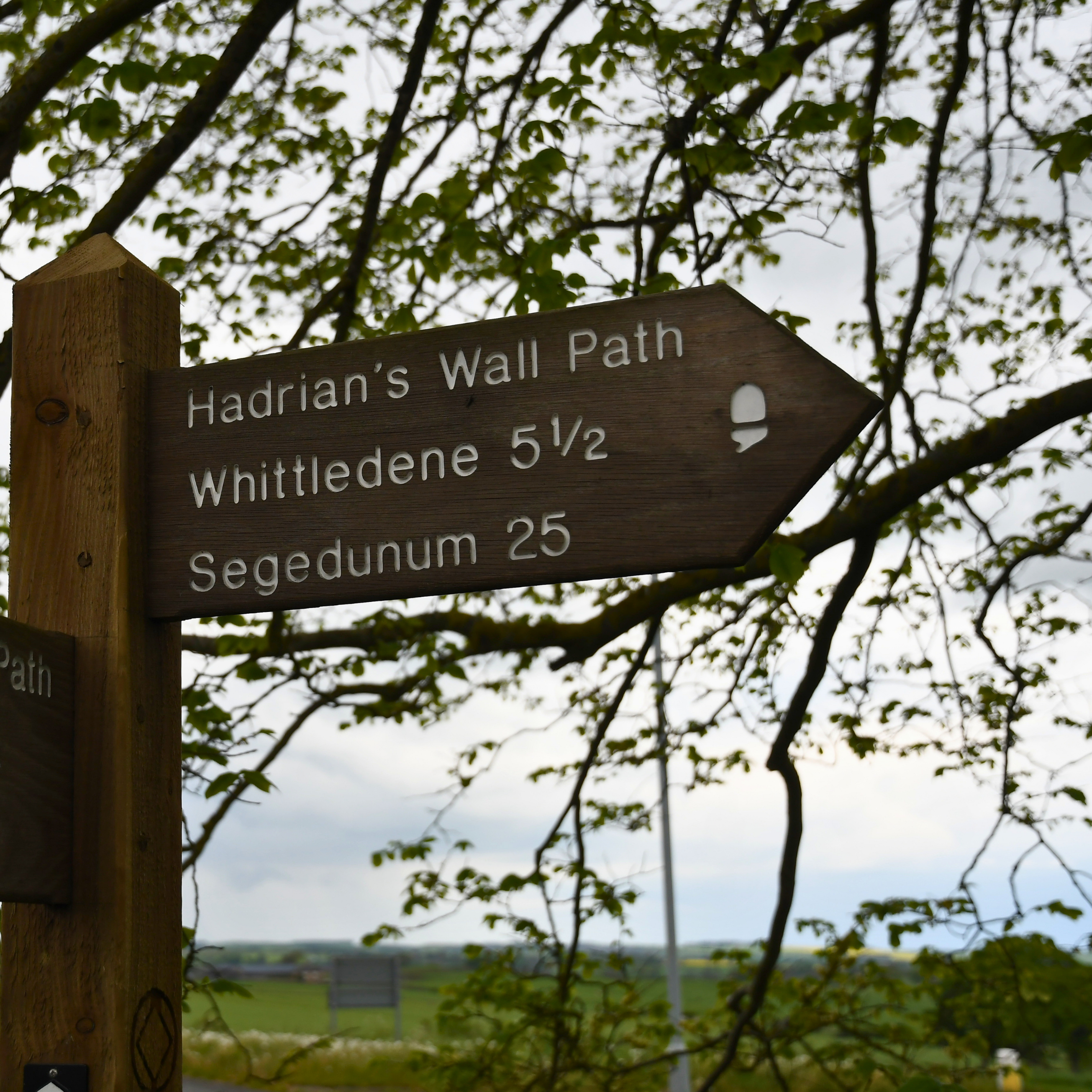
We wanted the experience of putting our feet in the sand on both coasts. So our first day, before the actual Wall trail, was a seven-mile warm-up walk from the beach at South Shields to Segedunum Fort at Wallsend, where the trail officially begins. The beach was reminiscent of Nantucket: sand hills, wooden fences, grasses, then rocky cliffs with remnants of a Roman fort at the water's edge. A rainstorm passed through in classic English style. We arrived at the fort, got our first trail passport stamp, and found our way to Colman's Fish and Chips across from our inn, which had some of the best fish and chips we've ever had. Then Newcastle Brown Ales at a pub nearby, because you cannot be in Newcastle without doing that. Beer was two-fifty to three-fifty a pint. A round for three of us was slightly more than the cost of one craft beer at home.
Day two was the first real day on the trail: seventeen miles to Heddon-on-Wall. About 95% of it was urban walking to get out of Newcastle, which was its own experience. In the first thirty minutes we saw a horse tied up in the middle of a neighborhood yard, a rat that was absolutely Scabbers from Harry Potter running ahead of us on the path, and a group of ten-year-old boys in school uniforms smoking in a school yard. One of them looked exactly like Neville Longbottom. We had walked through the heart of Newcastle along the River Tyne and its seven bridges, and then the urban landscape finally gave way to English countryside.
My shoes turned out to be wrong for this. I'd worn my hiking sneakers thinking the trail was flat and long. It is not flat. Multiple blisters had formed by midday. The lunch stop we'd been counting on, a place that was supposed to be good and also a brewery, turned out to be five hours into the walk rather than three, and the food was awful and the beer mediocre, but we trudged on.
Then the English countryside arrived properly: fields, flowers, farms, sheep being adorable and communicative in that specific sheep way where they all run toward the farmer at once and you can almost hear them saying "there he is, chow time." The four step trackers between the three of us were all disagreeing with the guidebook mileage in ways that turned out to be significant. Step trackers, we learned, measure steps, not geography. They had been lying to us about our fitness for years.
We reached Heddon-on-Wall and were told our inn was actually two miles farther. I shed a few tears at this information. I will not pretend otherwise. We walked the two miles. When the innkeeper opened the door and took one look at me she said I looked "shattered." I told her that was accurate. The pub in town served excellent food. I was asleep before I finished the blog post.
Day three brought hailstones while we were suited up in ponchos, which we took philosophically since we'd just put the ponchos on and at least they were getting used. The stiles multiplied throughout this section. Stiles are the gates and rock wall steps you climb over and through at every field boundary on the trail. They are everywhere. Jen, who is tall, became convinced they were built by giants based on the distance between each step.
My left knee announced itself on the downhills around midday. This is the knee that has given me trouble since childhood and had apparently decided that 13 miles of English farmland was the right time to revisit the issue. I took a lot of Aleve. We found two sections of Hadrian's Wall on this day and the age of it, standing right there alongside us, 2,000 years old, is the kind of thing you stop and just stand in front of for a minute.
The hardest section of the whole trail came next: nine miles but the biggest elevation changes we'd see. We started at Sycamore Gap, which you'd recognize from photographs or from Robin Hood with Kevin Costner, where the Wall dips dramatically and a single tree has grown at the lowest point. Beautiful. Then an extreme steep climb to the highest point on the entire trail, followed by a series of massive ups and downs, all following the wall as it runs over the hills. The wind was 30-40 miles per hour sustained, not gusting, just consistently blowing, which was actually helpful since the climbing had us working up a real sweat.
Looking back from the highest point at the wall going up and down over the hills into the distance, it genuinely looked like the Great Wall of China. I stood there and thought: good for Hadrian. He made something that lasts.
We got slightly lost and ended up at a farmhouse that was literally the only building for miles. A woman came out and told us we were off track and to cut through her barn to reconnect. Matt's highlight of the day was from the summit looking down at the highway below to see a string of MGs out for a Sunday drive, tiny and perfect in the best way.
Jen's heels were peeling off. This is not a metaphor. This is what happened. The skin on her heels was literally peeling away in sheets. It was shocking how fast it happened and it was genuinely very painful. A British man at breakfast the next morning who was also walking the trail, who had himself had to quit at Housesteads years earlier because of blisters and had been hearing about it from his friends ever since, gave us the biggest bandages we'd ever seen for Jen's heels. He was walking the trail solo for a second attempt to finish. He seemed more distressed by Jen's condition than by his own history with the trail.
We called a taxi from Housesteads to the inn rather than walk the last few miles. The taxi took about four minutes. With the continued ascents and descents it would have taken us two hours. There was no debate.
Day five was my birthday. We started with tea and scones at a shop that appeared at a fortunate moment during a trail diversion through a small flooded town, and Matt found a giant slide in a playground along the detour and used it. Then a bathroom appeared just when we all needed one, which felt like a birthday miracle.
The B&B that night was at Lanercost Priory, right on the property of a twelfth-century monastery that William Wallace ransacked and where King Edward I stayed while ill, eventually dying in a nearby town. The owner is a chef who used to run a hotel in Scotland and offered a three-course farm-to-table dinner for guests: Parmesan egg souffle with a runny yolk, grilled chicken with mushroom sauce and sauteed cabbage and potato and sea beans, and a traditional pudding with warm red currant topping. It was a genuinely wonderful meal. The owner who served it lingered at the table extensively in the way that hosts sometimes do when they want to be appreciated for longer than you have energy for at 9pm, but his stories were genuinely interesting so we forgave him.
When I came back to the room after checking in, there was a birthday cake with lit candles waiting for me. The owners had organized it. A lemon ginger pound cake. I got a little emotional. I had wanted a birthday that pushed and challenged me and this one had done that comprehensively.
Day six was fourteen miles to Carlisle. Flat farmland, warm day, the last of the interesting landscapes behind us. Long. We made up trail songs. We stopped at an "Honestly Box," which is a small roadside installation with drinks and snacks on the honor system for walkers, put out by someone in retirement to make a little extra money and do something kind. That cold water and candy bar on mile nine were genuinely important to me.
We passed other walkers in Carlisle who recognized us as having come from the east and shouted "You made it!" with raised fists. We looked, apparently, like people who had survived something. We had pizza at an eclectic hipster restaurant in the city and then sat there like zombies yawning at the table, surrounded by the bars and shops of an actually quite cool small English city that we were too broken to enjoy.
The last day was fourteen more miles. I switched to my Allbirds for the opening pavement section and I am endorsing those shoes publicly and without reservation: they are not hiking shoes but they are the most comfortable shoes I own and they got me through the final miles of England when nothing else would have.
The trail icon is an acorn and through the city diversion we hunted them on poles and bike racks and signs, keeping ourselves on course. An older man pulled over in his car to offer directions through a flooding diversion, just because we looked like we needed help.
The marshlands section was about three miles alongside a highway and felt three times that long in the heat. An ice cream bar at a small rest stop four miles from the end was possibly the best ice cream I've ever eaten. We took a wrong turn leaving and added a third of a mile. This was not a good moment.
One mile from Bowness-on-Solway, a retired man had made a sign and set it up to guide walkers through the last stretch and make himself a little extra income in the process. He was delightful and gave us the exact play-by-play of the last mile. I moved faster in that final mile than I had in two days.
Then we saw the sign for the trail end. Six hundred meters. Then the Irish Sea appeared.
We all took turns pressing our final passport stamp at the end marker. 91 miles. North Sea to Irish Sea. Coast to coast across England.
Would we do it again? I've thought about this. The honest answer is: yes, but differently. Would we do the full thing start to finish? No. We don't need the completion bragging rights. What we'd do is the highlights: Heddon-on-Wall to Greenhead over four or five days, the sections with the wall itself and the elevation and the big views, and maybe a rest day in the middle. The miles of urban pavement at either end are just miles of urban pavement. Much of the trail you are walking to finish it rather than for the trail itself.
But I don't regret a single step. And that's why we travel
Beyond Paris: Loire Chateaux, Mont St Michel, and Julia Child's Table
France | Loire Valley + Mont St Michel + Normandy
Getting the rental car out of Paris on day six of the 2013 trip involved Matt pulling up from the train station and announcing, "That was fun. I already pissed off a motorcycle and I have no idea why." I was immediately assigned one job: do not make any reactions. This is how we drive out of Paris together.
Once we were on the highway toward the Loire Valley it was fine. France has lovely toll roads that cost a completely unlovely amount. Fourteen euros for one hour on one freeway. We accepted this as the price of seeing Chenonceau.
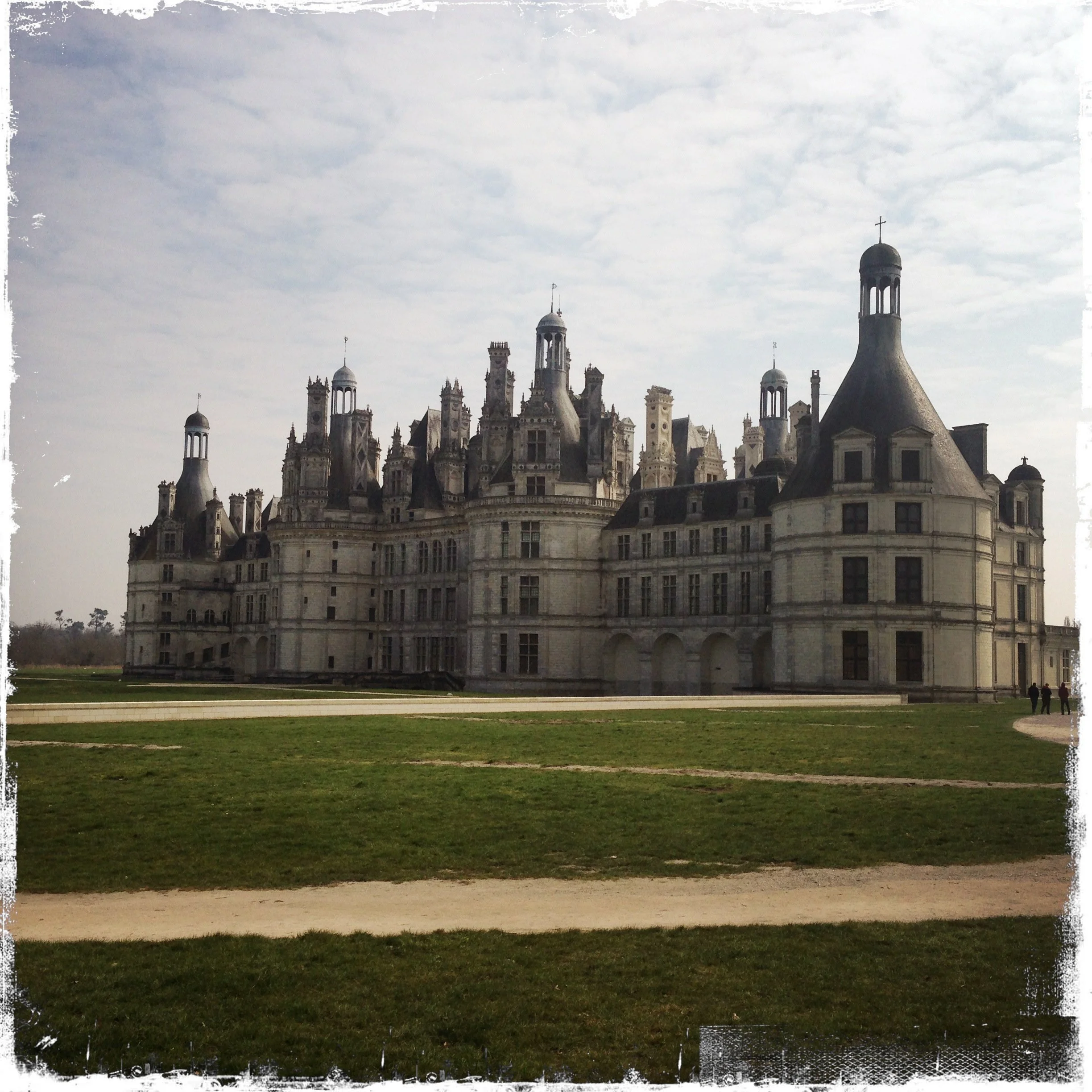
The Loire Valley is not what you imagine when you imagine the Loire Valley, meaning the chateaux are not clustered together like a fairy tale theme park. They're spread out by hours of driving, everything closes at five, and you can realistically only see two in a day. We saw Chambord first because it's the one everyone says is best. The exterior is breathtaking, genuinely breathtaking: 440 rooms, 282 fireplaces, 84 staircases, construction started in 1519. Inside it's almost completely empty, cavernous and freezing because it would take an entire forest of wood to heat the place, which explains why no one actually lived there for very long.
Lunch at the Chambord cafe was the worst meal we had in France. Possibly one of the worst meals of our lives. The coq au vin I ordered was fine. Matt ordered something with ham and white sauce and mushrooms and received what appeared to be a burnt frozen pizza baguette with meatballs. We left as fast as politely possible.
Chenonceau was everything Chambord promised to be. Original furnishings still inside, the most incredible flower arrangements and tablescapes throughout for Easter, the kitchen intact and full of atmosphere, the gallery stretching across the water. Built in the 1400s. Beautiful in a way that felt lived-in rather than staged.
This is also when I got sick. As I do, apparently, on vacations. A fever that hit hard by the time we reached our hotel in Amboise. I went directly to sleep. No dinner. Matt walked around town alone. I felt terrible about the whole evening and also just plain felt terrible. I had the best intentions of soldiering through.
Mont St Michel helped. We drove three and a half hours the next morning with me mostly sleeping and feeling like someone was banging on the inside of my skull. Mont St Michel has been there since 460 AD and seeing it appear in the distance as we approached was worth every foggy minute of the drive. It stands out there all by itself looking simultaneously ancient and impossible. Cars are not allowed anywhere near it. You park far away and take a bus to the base, then walk.
Everything at Mont St Michel is uphill and stairs. We made it to the abbey at the top, which is much larger than expected and genuinely impressive. The views out from the top are real. We came back down through the souvenir shops, looked at our watches, and realized we had seen the entire island in under three hours. I then slept for most of the afternoon, which my body needed more than any abbey.
Dinner at the hotel was a fixed menu that had lobster bisque as a starter, which sounds lovely and arrived with scallops in it, which I did not want and which didn't help my already uncertain stomach. The entrees were not worth describing. Dessert was sorbet and a crepe, which were fine. The beds, however, were extremely comfortable.
The Normandy section of this trip was Matt's territory. He had done his research thoroughly. We started at the Dead Man's Corner Museum in Carentan, which had some excellent Band of Brothers-related displays. Then north to a German Bunker Museum at the Sword Beach area where we toured all four floors of a fortified bunker, command center, communications room, and all. The Germans occupied France for four years before D-Day and what they built along that coastline during those four years is genuinely staggering: power, plumbing, air circulation systems, thick concrete everywhere. We stopped for food at the only available option, which was a French McDonalds, which operates on kiosks and serves specialty burgers with Camembert and goat cheese toppings that you will never see in America.
Our little apartment La Maison Matelot was darling. Matt had found it while researching the area. Three units in one building, all charming, all uniquely decorated. We picked the ground floor one specifically because it had a claw foot bathtub and we were not wrong about that decision. The apartment manager gave us dinner recommendations and we headed out to see a German cemetery and a calvados producer before the dreaded 5pm closing. The German cemetery was actually quite beautiful, sun on the grass, rows of dark crosses, very different in tone from the American cemetery we'd see the next day.
And then a bird pooped directly on my head. I had been finally feeling better, out in the Normandy sunshine, and a bird made its announcement from above. Matt cleaned it off while laughing the entire time. This is marriage.
The calvados producer was interesting but the product itself wasn't quite to our taste. We did find Pommeau, which is half cider and half calvados and served chilled, and that was lovely. We bought a bottle and it became one of the better decisions of the trip.
Dinner that night at L'Angle Saint Laurent in Bayeux was one of the best meals of the entire France trip. The apartment manager's recommendation. We were there when they opened at seven, ordered the 35-euro tasting menu, and let the kitchen run. Matt had foie gras, then beef tenderloin with foie gras on top with gnocchi, then goat cheese with fig compote, then a crepe filled with chantilly cream and flaming Grand Marnier. I had cauliflower soup with foie gras mousse and bacon, then sea bass with saffron cream and vegetables, then two local Normandy cheeses, then the same crepe. The amuse-bouche was a turnip and egg cream broth that Matt licked from the cup. We had a bottle of Pouilly-Fume from the Loire. Memories were made.
The full D-Day tour the next day was eight hours covering 120 miles and most of the significant sites. It was thirty degrees with a strong wind making it feel colder than that. We had gone to a store the day before and I bought an extra fleece and a hat, which was the right call. Our group of twenty loaded onto a minibus.
The German gun batteries at Longues-Sur-Mer were our first stop, four massive naval guns behind control bunkers, the last two in pristine condition. Matt was already in heaven and the camera was basically an extension of his hand at this point.
Omaha Beach. Four miles of it. High tide when we visited, so the beach itself wasn't visible, which meant you stood at the top and looked out at the water and tried to reconstruct from what you know. When you hear what the plan was for D-Day and then hear what actually happened, the fact that it worked at all is astonishing.
The American Cemetery is 172 acres and contains 9,387 servicemen. That number is the kind of thing that stops you mid-breath. The rows of white crosses seem to go on past what the eye should be able to follow. It is an extraordinarily moving place and I think it always will be, no matter how many times people visit.
Pointe du Hoc was my personal favorite, partly because of what happened there and partly because standing out on that cliff in thirty-degree wind felt appropriately severe for the history. This is where Army Rangers scaled a 100-foot cliff to try to knock out German guns that could fire on both Utah and Omaha beaches. The land is still cratered from the bombing. You walk among the craters and the blasted-out bunkers and it feels like the ground itself remembers.
Sainte-Mere-Eglise is the town with the church that has a fake paratrooper hanging permanently from the steeple, because an actual 101st Airborne soldier landed there on D-Day, got caught on the steeple, played dead for two hours, and eventually escaped. Fifty percent of the paratroopers who jumped that night were killed. That detail has stayed with me.
We went back to L'Angle for dinner again because why deviate from something excellent. Different menu, equally wonderful.
Our final day started with Gordon Ramsay's scrambled eggs at the apartment while we found new music on the CD collection there, then back to Sainte-Mere-Eglise where Matt found what he'd been looking for in the US and couldn't find: a large old German shell casing for his WWII gun room. Then an antique shop produced an old German helmet, complete with bullet holes, at a fraction of what it would cost at home. He was very happy.
The final stop of the entire France trip was in Rouen, and it was mine. Julia Child. The whole trip had been in her orbit in some way: the cooking classes, the kitchen shop where she bought her equipment, standing outside the apartment she shared with Paul on Rue de l'Universite. But this was the real pilgrimage.
La Couronne in Rouen claims to be the oldest inn in France, established in 1345. Julia Child ate there for the first time in November 1948, on her way to Paris with Paul, stopping for lunch from their Buick. She described it as the most exciting meal of her life. The moment that changed everything. If you saw Julie and Julia you know the scene with Meryl Streep and Stanley Tucci going absolutely still over that sole. That was here. That was this table.
I ordered the sole meuniere, naturally. The waiter brought it whole on a presentation platter, perfectly browned, butter sauce still sputtering, then wheeled it to a side table and filleted it in under a minute. Four perfect fillets on my plate. Bon appetit.
I closed my eyes. Then I took a bite and chewed slowly. The butter. The mild salty fish. Julia called it a morsel of perfection. I understand completely. I can see exactly how one lunch in 1948 became the beginning of a life.
We drove to the airport full and happy and a little sad the way you always are at the end of something that was genuinely good. Au Revoir, France. You keep outdoing yourself.
The Hills Are Alive (And So Is Hitler's Eagle's Nest)
Austria + Germany | Salzburg + Berchtesgaden + Rothenburg + Munich | October 2011
I had a cold going into Salzburg. I'd felt it coming the day before we left, dosed myself on Zicam, thought I'd won that particular battle on Saturday and Sunday, and woke up in Mittenwald knowing I had lost. Very sniffly. Sneezing constantly. Not slowing down even slightly.
We had a wonderful breakfast at our Mittenwald guesthouse, where the owner brought out soft-boiled eggs wearing tiny knitted covers: Matt's was a ski hat and mine was a chicken. I am telling you this because it was the most charming thing and deserves to be in a permanent record somewhere. We spent a pleasant morning walking the town, which is quintessentially the German village of your imagination: neat shops, flower boxes, cappuccinos outside in the cool air. The pharmacy was a highlight of the day from a purely personal health standpoint.
The drive to Salzburg was mostly Autobahn through Austria, beautiful the whole way. Matt had figured out the in-car GPS by this point, which worked better than the Garmin they'd given us because the Garmin narrated every instruction and constantly announced "recalculating" in a tone that I would equate to nails on a chalkbord. We turned on the radio for the drive and discovered that Austria has a profound love of Elton John and the Lion King soundtrack. Both were on multiple stations multiple times in one trip. Also: "Born to Run" covered in German. Go Jersey.
Salzburg is smaller than we expected. Beautiful but compact. The big fortress on the hill dates to the 1400s and offers views that justify the climb. We found a small outdoor cafe at the top with apple strudel and a view of the Austrian countryside that made the steep climb worthwhile.
Day two in Salzburg was the Sound of Music tour, which I will defend to anyone. We rewatched the movie before leaving so we'd have context, and on the bus our guide was a genuinely wonderful older man who'd lived in Boston for ten years, which explained his impeccable English. He had a radio broadcaster's voice and a laugh that made you laugh too. We saw the mansion used as the grounds, drove past the lake where Captain Von Trapp finds the children in the trees, visited the gazebo where "I am sixteen going on seventeen" was filmed, and drove out through the Lake District to the church in Mondsee where the wedding scene was filmed. The bus played the soundtrack the whole way and yes, everyone sang. Every person on that bus sang. Including Matt.
The Mirabelle Gardens where the Do Re Mi scene was filmed are just across the street from old town. Very pretty gardens, very much what they look like in the movie. We felt obligated to also visit the Mozart museum nearby since Salzburg is his birthplace and all. We were pretty disappointed for the twenty dollars. The only thing worth seeing was an original Mozart piano, which was astonishingly, amusingly tiny.
We ended the Salzburg evenings at the Augustiner Braustubul, a beer garden with indoor food stalls selling rotisserie chickens and traditional Bavarian fare. You pick what you want from the stalls, carry your tray outside, and rinse your ceramic stein with water at the tap before they fill it. We had bratwurst, two kinds of kielbasa including one filled with cheese, and a giant pretzel. Cold beer, outdoor seating, the day cooling off around us. This is exactly what we wanted Germany and Austria to feel like.
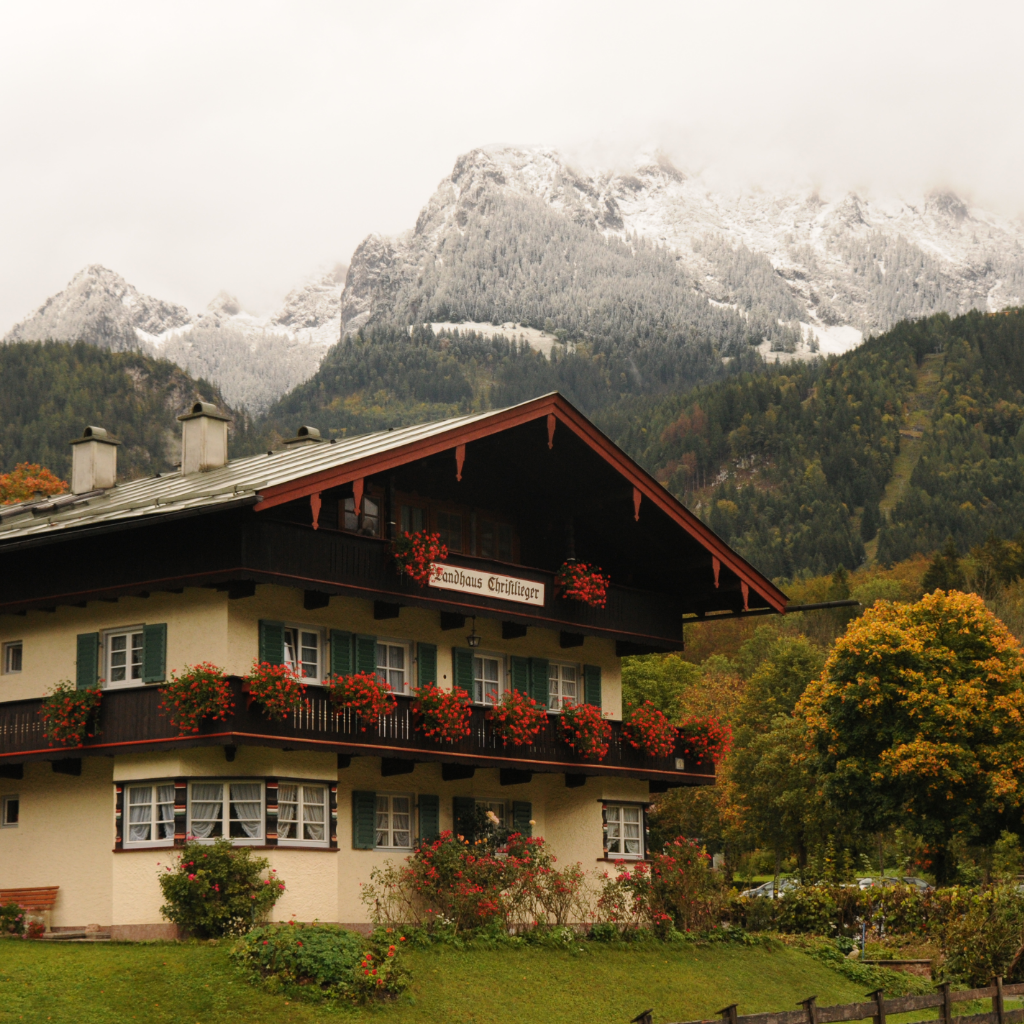
After Salzburg: Berchtesgaden, thirty minutes away and a completely different world. The Alps arrive immediately as you leave the city and they do not stop.
We had planned to stop at the Steigl Brewery on the way out of Salzburg, and we did. They opened at ten and we were there eager and waiting. Outdoor seating, gift shop, a hundred dollars on souvenirs because we love zee beer and felt no shame about it. We sat outside with a wheat beer for Matt and a grapefruit Radler for me at ten-thirty in the morning. I say, “When in Germany…”
Hotel Zum Turken in Obersalzberg. This is a hotel with a history. An 80-year-old woman named Ingrid Scharfenberg runs it, the same family that has owned it since her grandfather purchased it in 1911. The guesthouse was well-known and had famous guests. In 1933, Martin Bormann, Hitler's third-in-command, visited repeatedly trying to purchase it. Her grandfather declined. So the Nazis did what the Nazis did: forced the sale at an insultingly low price and sent her grandfather to Dachau, where he died a year later. The SS used it as their Obersalzberg headquarters. In 1945, American bombs hit the property. The Allied Forces held it until 1947. In 1951, the decision was made to demolish all Third Reich structures in the area, including Hitler's Berghof home next door. At the last moment, Zum Turken was spared and sold back to Ingrid's mother.
Walking in is a time warp. Large skeleton keys. Matt noted it was the first place he'd ever stayed where you can genuinely peep through the keyhole of your room. Ingrid is five feet tall at best, with perfect English, and greeted us warmly and told us to treat the place like home.
The hotel sits above part of the Nazi bunker system, and Ingrid still mans the entrance herself. She gave us maps, oriented us to the area, and we descended a spiral staircase into the bunkers. Long concrete corridors, metal clips on the walls where electrical wiring was run, machine gun shelters. The tunnel that once led to Hitler's Berghof has been bricked off, but you can see where it went. It is simultaneously fascinating and deeply strange and you feel both things at once the entire time you're down there.
We walked to where the Berghof once stood. Only the foundation wall remains, built into the hillside. The views from that spot are extraordinary. This is why Hitler spent a third of his time here: the position, the seclusion, the mountains. Our room balcony had the exact same view as the Berghof and looked down on the old driveway. Matt noted that at least we both had good taste in views. I am choosing to take this at face value.
A short trail leads to the Documentation Center, which is probably the only museum in Germany dedicated to the full Nazi history: Hitler's rise, the war, the defeat, all of it with a comprehensive audio guide. It sits above an additional set of bunkers, much larger than the ones under Zum Turken. You could drive a vehicle through most of these tunnels.
We asked at the bus ticket station about the employee bus up to the Eagle's Nest that Ingrid had mentioned. The ticket agent seemed to be saying "no no," which turned out to be "snow snow" because there was snow forecast and NO buses would run the next day. The Eagle's Nest sits at 6,000 feet and it was 72 degrees in town at that moment. We caught the last bus up that afternoon.
The Eagle's Nest was a gift from the Nazi state to Hitler for his fiftieth birthday, reached by a four-mile road that goes virtually straight up with your ears popping the entire way, then an elevator lined in brass to the very top. It's a restaurant now but completely original inside, old photographs showing it looking almost identical to today. Standing in that space with the Alps spread out in every direction below you and knowing its history is a specific and strange experience.
That evening on our little balcony at Zum Turken: cold Steigl beers, the sun going down behind the most magnificent mountains I'd ever seen, the valley and town below, the green hills. Most people's paradise is a beach, or somewhere tropical. Mine is this: an Alpine view at dusk with good beer and the person you love most. We will never forget it.
Rain and snow on the mountains the next day, which meant the Eagle's Nest was indeed closed, and we were glad we'd gone up the evening before. We drove through Berchtesgaden National Park, stopped at adorable little towns, and Matt extracted a Sound of Music twirl from me on a mountain despite the cold. The highlight was a short boat cruise on Konigsee Lake, a mountain lake surrounded by walls of rock. The boat captain cut the engine halfway up and played trumpet so you could hear the echo against the rock walls come back across the water. That was pretty special.
From Berchtesgaden we drove four hours through a mix of heavy wet snow and construction to Rothenburg ob der Tauber. We arrived at one-thirty, checked into our hotel directly across from the main square, walked outside for twenty minutes, and immediately cancelled our Munich hotel reservation for the following night.
Rothenburg is a completely walled medieval city dating to the 1100s. Many buildings from the 1400s. Some wooden city gates still original from the 1500s. Cobblestone streets in every direction. You can walk anywhere and eventually find your way back because the wall means there's a limit to how lost you can get. It is storybook in the most literal sense of the word, and we spent two full days just wandering and exploring and eating and walking the top of the wall.
The Night Watchman tour on our first evening was perfect. The guide sounded like he had walked directly out of Monty Python, was both informative and consistently funny, and did a dramatic reading of local medieval history that made a genuinely hilarious evening out of plague mortality statistics. This is not easy to do.
Munich was our last stop before the airport. Hofbrauhaus for lunch, founded in 1589 by the Duke of Bavaria: huge wooden tables you share with strangers, years of carved names in the wood, liter beers, pretzels the size of your head, and a band playing traditional music. We swayed and bobbed our heads and ate our last sausages and sauerkraut and didn't want to leave. Then old town, a brief hop-on hop-off bus until it made us too sleepy to continue, then Hofbrauhaus again for dinner. Germany was everything we hoped it would be and we already want to go back.
A few German observations that belong on the record: Germans take walking sticks seriously. Not just for hiking. In towns. On flat roads. Both hands. Everywhere. The Autobahn left-lane etiquette is miraculous: people actually move over when faster cars approach and the whole thing flows like it was choreographed. Beds in Germany have no top sheets, just an enormous poofy duvet, which is wonderful except when your feet poke out the bottom. Beer is always the local variety wherever you are. There is no national brand loyalty. You drink whatever is made near where you're sitting. This is an excellent system.
The best moments were Matt and I breaking spontaneously into Edelweiss or a Sound of Music number at random moments in the car. This happened more times than I can count and I regret nothing.
Red Square to the Alps: Moscow, Dachau, and a Fairytale Castle
Russia + Germany | October 2011 |
We flew to Germany via Moscow, partly for the routing and partly because spending a day in Red Square seemed like exactly the kind of thing we do. We flew Aeroflot, the Russian national airline, and I want to describe the flight attendants: matching uniforms in bright orange, high heels, coordinating scarves, and cute little hats bobby-pinned to their heads. It was exactly like the PanAm TV show from that era except in orange. Very 1960s. Very fabulous.
We landed in Moscow around one in the afternoon, cleared passport control without issues, and met our day guide Irina, who pronounced her name exactly like mine but with an "a" on the end. She was a middle school history teacher who guided on weekends. Quiet but extraordinarily informative. She took us by express train into the city, then the metro to Red Square.
Entering Red Square and seeing St. Basil's Cathedral for the first time is one of those moments where Matt and I just looked at each other and said: Can you believe we're actually here? Red Square doesn't disappoint. The Kremlin on one side, the History Museum on another, St. Basil's at the far end, the specific quality of the air in that enormous open space that makes the whole thing feel like theater. Moscow was much more European and much more modern than we'd expected, which almost every city outside of the US turns out to be.
The Kremlin means "fortress" and inside it there are presidential administrative offices, three cathedrals, two churches, all original. The interiors are beautiful. Napoleon used them as horse stables and a winery, which the Russians have not forgotten.
The Cathedral of Christ the Savior is their national cathedral, reconstructed in 1991 after Stalin had the original blown up in 1931 because he felt it was too close to the Kremlin and religion should be kept at a distance. The rebuilt interior is beautiful. Some interesting facts Irina shared: Russian Orthodox churches have no sculptures, only icons. The congregation stands for the entire service, no pews. No musical instruments, only choirs.
Irina took us through several different metro stations on our way back to the airport, each one architecturally distinct, several featuring extraordinary mosaics and marble. The Moscow metro is genuinely one of the more beautiful transit systems in the world and almost no one outside Russia seems to know this.
Our six hours in Moscow were up. The flight to Munich that followed was one of the smoothest landings we've experienced. People applauded when we touched down. Matt got us a rental car for the rest of the trip: a Peugeot 508 with a full glass sunroof, which we were delighted by. The navigation system was entirely in German, and after fifteen minutes of Matt pressing every button in the car while I paged through an equally German owner's manual, we went back inside and asked for a portable unit.
The car itself was a manual, because automatic rentals in Europe are essentially impossible to find and cost double when you do. This presented no problem until Matt tried to reverse in a parking lot to correct a missed turn and the car went forward. He tried again. Forward. He tried lifting as he shifted. Lurch forward. Ten more minutes with the owner's manual revealed that the Peugeot's reverse requires you to lift a small inset ring under the shift knob before shifting. This is information that would have been helpful earlier. It was genuinely very funny and we made it to the hotel by midnight.
The first full day in Germany began at Dachau. We drove through the most pristine countryside to get there: lush green hills, farmland, barns, picture-perfect towns, no dilapidated buildings, no broken-down vehicles, the kind of orderliness that makes you feel you're driving through a film set. The contrast with where we were going was not lost on us.
The morning was foggy, which was the right weather for Dachau. Not the cheerful blue-sky morning you'd want for most sightseeing. The fog gave the site a quiet, surreal focus. Dachau was the first Nazi concentration camp, established in 1933, and all subsequent camps were modeled on it. The death toll of 32,000 recorded deaths is lower than Auschwitz but the significance is in what it represents: the prototype. The original.
The bunkers have been reconstructed, two of them, so you can look inside and see the wooden box bunks stacked up. Each bunker was designed for two hundred people. Most held over two thousand. The crematorium and gas chambers are original. They eventually built a second one because the first couldn't keep up with the volume of bodies arriving from other camps. We spent a couple of hours walking the grounds and the museum. These places do something to you that is hard to name and harder to shake.
Then we drove toward Neuschwanstein.
Within ten minutes of leaving Dachau's surrounding area we were back in alpine Germany and the contrast was absolute. The mountains appeared. The landscape turned green and impossible. Matt settled into the Autobahn with what I can only describe as joy, driving at whatever speed he chose and shouting random German words out the window to express excitement. The drive took an hour and a half and it was the most beautiful driving we've done anywhere. Perfectly maintained countryside the entire way. Then the castle appeared at the top of the mountain with the Alps rising behind it.
We stayed at Villa Jagerhouse, which sits directly between the two castles, Neuschwanstein and Hohenschwangau. Our room had a view of Hohenschwangau from the window. At a local restaurant with a full view of both castles, we had our first proper German meal of the trip: beer, pretzel, and sausage. The pretzel alone was worth the flight. Enormous, crunchy on the outside, perfectly soft inside, nothing like what gets sold as a pretzel at home. I said at the time that it reminded me of the first real bagel I had on the East Coast after years of eating the dense hockey-puck version on the West Coast. Pretzels have a correct form and Germany knows what it is.
Matt's last-minute decision to catch the final bus up to Neuschwanstein for sunset turned out to be one of the best decisions of the trip. The light on the mountains. The castle above. Perfect in a way you want to hold onto.
Dinner that evening included pork knuckle with dumpling and sauerkraut for me and deer with spaetzle and Brussels sprouts for Matt. A nice bath in the hotel's excellent tub. I read the Hunger Games until I remembered Germany came first.
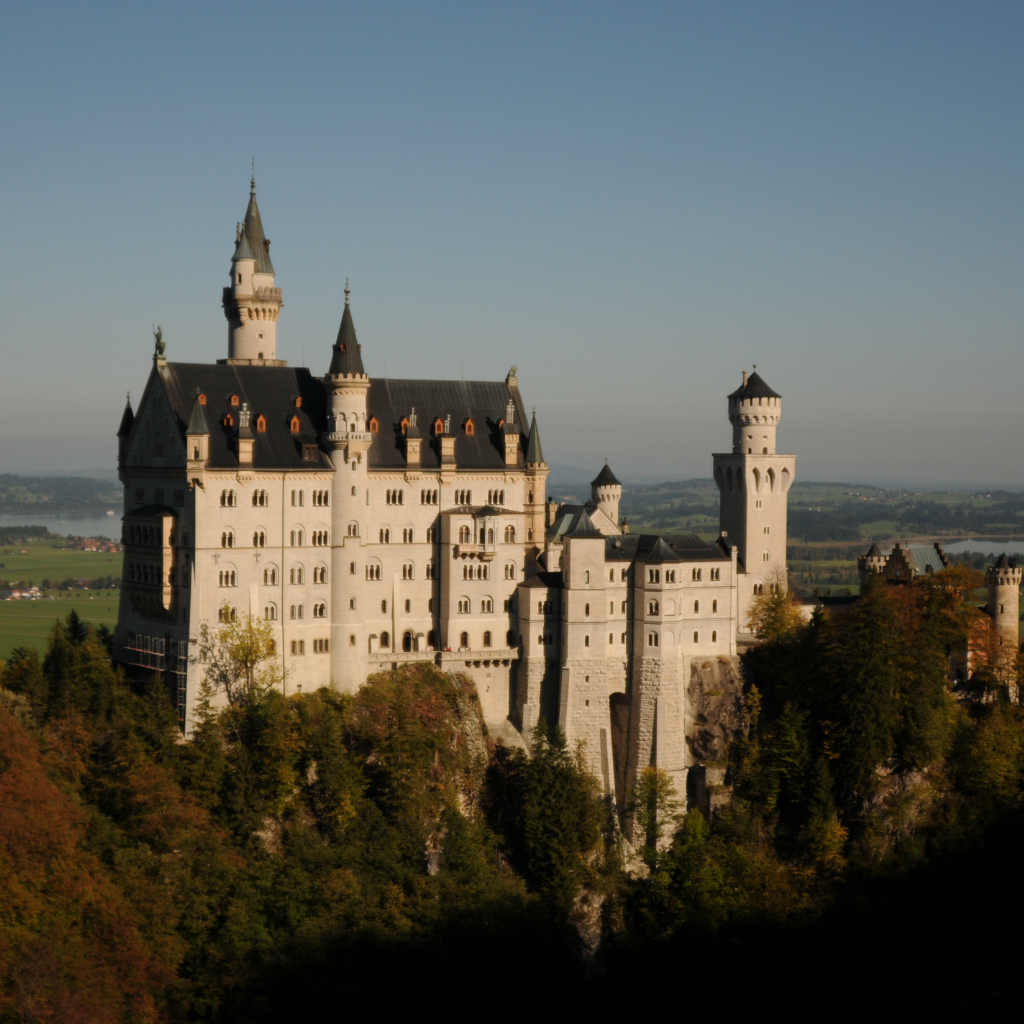
Tour of both castles the next day: Hohenschwangau first, where King Ludwig II grew up and watched Neuschwanstein being built across the valley. Then Neuschwanstein itself, which is the castle Disney's Sleeping Beauty castle is directly modeled after. Ludwig lived in it for only 172 days. He was arrested there, declared unfit to rule, and found dead by a lake outside Munich the following day under circumstances that have never been explained. The interior was only thirty percent completed when construction stopped. Within six weeks of his death people were paying to tour it. Our Rick Steves guide called the interior underwhelming compared to Hohenschwangau. Rick Steves was wrong. The level of detail in every finished room, the paintings and woodwork and mosaic floors, was extraordinary. No photos allowed inside either castle, which is a rule that exists and is enforced and which made us sad.
We hiked up to the St. Mary's Bridge both evenings for photos from the best vantage point. People leave engraved locks on the fence there, names joined together. Romance at its best. On the walk back down we stopped for a liter of beer, which is the size of Matt's head. I am not exaggerating.
From the castle we drove to Mittenwald, deep in the Alps, through Oberammergau and the most beautiful stretch of road we'd driven yet. The guesthouse we stayed at was run by a warm and friendly woman who gave us a dinner recommendation with a specific endorsement: a chef who had received stars at his previous restaurant in another town had moved to Mittenwald, opening without stars, and she said his cooking was top notch. She was completely right. The restaurant was cozy and they brought us Prosecco to start. The chef came out and gently asked if we spoke any German. We did not. He tried to describe the tasting menu in basic English. We said "four courses, yes please" and let him do his thing. Every course was extraordinary. We took a walk through the lit-up town after dinner in the crisp mountain air before coming back to sleep.
Czech Us Out: Three Days in Prague and One Unforgettable Chandelier
Czech Republic | Prague + Kutna Hora | March 2009
We had a 7:20am flight from Paris to Prague, meaning our taxi was at 5:30am, meaning we were running on not enough sleep and a lot of enthusiasm. An hour and a half later we were in the Czech Republic and the city from the window of the cab to the hotel was not giving me the feeling I was hoping for. A little gray. A little rough around the edges. Not what the pictures had suggested.
Then we found the old town. The love began immediately and did not stop.
Prague is beautiful in a way that is genuinely different from other European cities we've visited. The architecture is its own thing, older and more ornate in places, the streets more labyrinthine, the overall atmosphere more quietly dramatic. Once you are in it rather than around it the city opens completely.
We were hungry and disoriented by a new language that shares essentially zero words with anything English, a new currency, a new city. We found a traditional Czech restaurant and ate pretzels, sausages grilled until they split, mustard, sauerkraut, goulash, and hot mulled wine. I am a person who loves all of these things and the combination of all of them at once, in a wood-paneled restaurant in Prague, on a cold windy afternoon, was as good as you'd imagine.
Dinner our first night was at Z'Vatisi restaurant, which I had researched and reserved, and which I will put in our top three meals of all time with no hesitation. The restaurant allowed you to build your own tasting menu, mixing and matching any number of courses from the full menu, and we went deep into it. I had a pan-seared pepper-crusted beef carpaccio to start, then a porcini mushroom risotto with truffle oil, then a Bohemian sampler: crispy duck with red cabbage and herb dumpling, roast rabbit with slow-roasted pork belly, beef tornado with vegetable sauce and cranberries. Matt started with a pumpkin-pear soup with cinnamon cream, then sea bass with citrus rosemary sauce, then lamb chops crusted with violet mustard and lavender gremolata. We shared the best apple strudel with creme anglaise for dessert. Every plate was beautifully presented. The atmosphere was elegant and the service impeccable. We walked out into the Prague night feeling like the trip had already been worth it and we'd only been there six hours.
Day two started with St. Nicholas Church and Prague Castle, which involves a sustained uphill climb that your legs will register for the next twenty-four hours. The castle complex is vast: huge plaza, multiple churches, great views of the city below. We then walked a mile to a monastery famous for its library, which genuinely deserved the fame. Barrel-vaulted ceilings, floor-to-ceiling shelves, the smell of very old books. Lunch there was soup in a bread bowl: I had cabbage soup (sweeter and milder than sauerkraut), Matt had goulash. Both good. The only downside was the restaurant playing 1990s English-language pop hits at volume. Sting in a monastery in Prague while eating my sauerkraut soup is not the specific atmosphere I was hoping for.
The evening was one of those evenings you try to burn into permanent memory while it's happening. We wandered back to the old square and found a cafe with outdoor seating and heaters. Mulled wine, cappuccinos, dessert, the cold night air, the old square lit up around us. Matt had been shooting night photos from Charles Bridge. Breathtaking views. Very cold. We needed the mulled wine.
I remember writing in my notes that night: I don't know if life will bring us back to Prague, and I don't want to forget this evening. I still don't want to forget it.
Our last day we took a tour to Kutna Hora, about seventy miles outside Prague. It's one of the oldest towns in Bohemia, once a major silver mining center with a population larger than Prague's. Now a small city of about twenty thousand. The reason most people go is the Ossuary.
Kutna Hora lost thousands of people to the Black Plague and the cemetery ran out of room. They excavated forty thousand graves and eventually invited an artist to do something with the bones, which were just piled inside a church. What he created is exactly as extraordinary as it sounds. The chandelier alone is made from every bone in the human body. The entire space is decorated with human remains in patterns and arrangements that are, depending on your constitution, either deeply unsettling or deeply beautiful. We found it remarkable and unique and absolutely worth the trip.
After the Ossuary we walked the town of Kutna Hora, which is genuinely lovely: cobblestone streets, great small buildings, a cathedral with a unique three-peaked roof that is one of its kind. Lunch at a local restaurant produced our second-favorite meal of the trip. They brew their own dark beer on site. Our tour guide recommended it specifically, telling us it was not like Guinness but dark like caramel and, with a meaningful pause, "very popular with the ladies." I ordered it immediately. It was delicious. I have thought about it since.
Most of lunch was spent talking with a family from Liverpool: father originally from Ireland (I caught about 60% of what he said, because English only gets you so far in certain Irish accents), mother, and a daughter who clarified things for us when needed. The father works with someone from New Jersey and did a genuinely impressive impression of the accent. He dreams of visiting the Black Hills of South Dakota, which is the most surprising American travel aspiration we've ever encountered. He also referred to police stations as "sheriff stations" because he watches too many Westerns, which his daughter confirmed immediately with an eyeroll.
The Mozart evening did not land. We had tickets to Don Giovanni “Opera” at the Estate Theatre where Mozart himself had debuted the opera in 1787. This sounded wonderful. Two singers in period costumes that had seen better days performed for an hour. Halfway through I looked at Matt and he was asleep. I then noticed that approximately three-quarters of the audience was also asleep. I whispered this to Matt. He woke up and was overtaken by the specific type of giggles that are impossible to stop in a quiet room. You try to hold them in and they get worse and the snorts begin and then the person next to you starts too. The opera lasted one hour and felt appropriately long.
A few Prague observations worth preserving: the metro escalators descend at a forty-five degree angle for what feels like the length of a city block at a speed that makes you genuinely question whether you will make it to the bottom. There were at least four moments I thought I was going to fall into the void. The beggars on Charles Bridge kneel face-down on the cobblestone in what feels like a complete surrender or submission, holding out their hands. You can't see their faces. We gave money every time. It felt inadequate every time. And the cobblestones of Prague are spectacular and absolutely merciless on anyone wearing anything with a heel. European women navigate this in heels with what looks like zero effort. I do not know how they do it.
Prague was a complete and wonderful surprise of a city. We're glad we went. We'll be back…
The City That Started Everything (And Never Stops)
France | Paris | March 2009 + March 2013 (4th and 5th visits)
Paris is our travel home. We've been there more times than anywhere else on earth, and every single time the cab comes around a corner and I see the city appearing outside the window, I feel it. That specific thing. I don't have a word for it, but it's somewhere between relief and joy, like being let back in somewhere you belong.
Our first return trip together after our Honeymoon (which was our second visit together) was in 2009. We arrived the way you always arrive after an overnight flight: feeling like we might not survive the day. Then we got to the hotel, found out there'd been room flooding and they'd moved us into a full apartment down the street with a kitchen and a balcony, and suddenly we felt completely fine. Paris has that effect.
We started at Cafe de Flore on Boulevard Saint-Germain because that's what you do, you sit outside on the sidewalk in the sun and watch Paris go by and eat baguette that doesn't need butter and couldn't be improved by it. Paris baguette is its own category of food. Perfect chew, perfect crust, soft interior, that specific flavor that doesn't exist anywhere else. Matt had ham and eggs with gruyere. I had Welsh Rarebit, which is not rabbit, it's a molten cheesy baked thing on toast and it's wonderful. The real highlight was the Kir: white wine with black currant liqueur, entirely French, entirely perfect at any hour including lunch. We were there two hours. We didn't rush.
That trip we visited the Musee de Cluny, which holds our beloved Unicorn Tapestries from 1500, one for each of the five senses. We have a small replica of one in our dining room. Matt swears the Cluny has the best ceiling in Paris and also the best doorknobs, which is such a Matt thing to care about and I love it. We went to Sainte-Chapelle, which has some of the largest stained glass windows in the world and takes your breath away every time. Then bought tickets to a classical violin concert inside Sainte-Chapelle that evening. Pachelbel, Mozart, and Vivaldi while the sun went down outside and the light faded through those extraordinary windows. I got a little emotional. Some things you don't want to end.
Pere Lachaise Cemetery was a full afternoon. 105 acres, Jim Morrison, Chopin, Oscar Wilde, thousands of other graves in a labyrinth of narrow stone paths. I had visited in 1996 and been moved by one particular grave: two people buried side by side with their hands joined on top, connected in stone. I'd taken a picture of it then but didn't have the name. Finding it again in 105 acres of graves felt impossible. Literally two minutes after I thought about it, there it was directly in front of me. I still can't fully explain that.
The Moulin Rouge did not live up to billing. Matt's exact quote was that "it sucked ass," and the Rockettes in New York are a thousand times better and they're not even topless. That is a direct quote and I stand behind it.
The 2009 trip was also when we finally got the Paris photos we'd always talked about. We'd once planned to come to France and elope. That plan changed, but our desire for photos in the city never did. So for our tenth anniversary together we hired a photographer named Bruno Cohen, who takes stunning photojournalistic-style portraits. Three hours of jumping over puddles, running, pretending to feed ducks, doing an authentic European double-cheek kiss. Bruno had been to Secaucus, New Jersey, somehow, which made us love him even more.
By the 2013 trip it was our fourth visit together and the comfort of it was different. You navigate differently when a city has become yours. We had a full apartment in the Marais neighborhood and immediately went to the market to stock up on Nestle caramel custards, because they sell them in French grocery stores and I would eat them at every meal if allowed. They are nothing like what you buy at home. They taste like creme brulee in a little pot and they cost less than a euro.
On that trip I took two classes with La Cuisine Paris, which I would recommend to anyone who loves food and Paris in any proportion. The first was a market class, starting at the Maubert market with our chef instructor Eric, who had worked in two-Michelin-star restaurants, spent time in Washington DC and Australia, and briefly on a cruise ship before concluding that cruise ships were not for him. He walked us through the market explaining produce, seafood, cheeses, the difference between how Parisians actually shop versus how tourists imagine they do. Then back to the school on the Seine to cook: zucchini veloute with goat cheese whipped cream and mint, duck breast with potatoes cooked in the duck fat, roasted vegetables, and an almond cream cake with roasted pears. Wine and bread throughout, because what meal would be complete without both. I also discovered my new favorite dessert: Paris-Brest, a choux pastry filled with hazelnut cream. The name is what it is. We all enjoyed it enormously.
The second class was baguette-making with Eric again, which I took partly for the pure obsession with it and partly as a personal tribute to Julia Child. Eric taught us that a proper French baguette has exactly four ingredients: flour, yeast, water, salt. That is the law. They check. Everyone in France buys baguette every single day. It is not optional, it is a part of the rhythm of life. I made four small baguettes and some focaccia, about twenty minutes of kneading each, and went home with flour on my shirt and a deep new respect for every person who makes this for a living.
Matt spent those mornings at the Musee de l'Armee and Invalides, the Louvre, Montmartre and Sacre-Coeur, including climbing the 300 steps to the dome for the views, which his calves reported back on at length. He also watched a ring scam operate outside the Opera Garnier, where a person pretends to find a gold ring on the ground and then presents it to you as if you owe them for the discovery. As he was telling me the story, the exact same scam was happening ten feet behind him. Paris is endlessly consistent.
Versailles on this trip was one of our best days. We got a tip from the information desk about a guided tour for seven euros more that grants access to the private royal apartments and the Opera House. The Opera House was built specifically for the wedding celebrations of Louis XVI and Marie Antoinette, who were fourteen and fifteen years old at the time. The whole thing was completed in two years because Louis XV wanted it faster and wood was cheaper than marble. Sitting in a room like that and knowing that history is what Paris keeps doing to you, stacking centuries on top of each other until the weight of it becomes something almost physical.
Marie Antoinette's Trianon estate had pink marble on the outside and bold colors inside and everything about it was extremely her. She had 10,000 shoes at her death and is credited with starting French fashion. The French people actually adored her, which is not how the story usually gets told.
Notre Dame on this 2013 trip was the 850th anniversary, which meant there was a giant structure out front blocking the full view for photographs, which I found personally irritating. But inside, I lit a candle for my dad the way I do every single time I'm there. I think about my first trip here in 1996 when I was young and he was so excited for me, little-kid excited, in the way parents get when they know something big is about to happen to their child. He gave me that trip. Paris changed my life on that first visit and everything that came after it is in some way traceable back to him standing there being excited on my behalf. So there's always a candle.
Sainte-Chapelle on a sunny day, when the light comes through those windows and the whole interior turns colored and luminous, is one of the most beautiful things I've seen anywhere on earth. It never fails. It never will.
The apartment, the market runs, the morning coffee, the easy familiarity of knowing which streets to take. This city keeps giving us new things to find and lets us feel at home at the same time. Je t'aime, Paris. Every time.