Africa | Europe | Middle East | South Asia | China | Latin America | Nordic
Red Square to the Alps: Moscow, Dachau, and a Fairytale Castle
Russia + Germany | October 2011 |
We flew to Germany via Moscow, partly for the routing and partly because spending a day in Red Square seemed like exactly the kind of thing we do. We flew Aeroflot, the Russian national airline, and I want to describe the flight attendants: matching uniforms in bright orange, high heels, coordinating scarves, and cute little hats bobby-pinned to their heads. It was exactly like the PanAm TV show from that era except in orange. Very 1960s. Very fabulous.
We landed in Moscow around one in the afternoon, cleared passport control without issues, and met our day guide Irina, who pronounced her name exactly like mine but with an "a" on the end. She was a middle school history teacher who guided on weekends. Quiet but extraordinarily informative. She took us by express train into the city, then the metro to Red Square.
Entering Red Square and seeing St. Basil's Cathedral for the first time is one of those moments where Matt and I just looked at each other and said: Can you believe we're actually here? Red Square doesn't disappoint. The Kremlin on one side, the History Museum on another, St. Basil's at the far end, the specific quality of the air in that enormous open space that makes the whole thing feel like theater. Moscow was much more European and much more modern than we'd expected, which almost every city outside of the US turns out to be.
The Kremlin means "fortress" and inside it there are presidential administrative offices, three cathedrals, two churches, all original. The interiors are beautiful. Napoleon used them as horse stables and a winery, which the Russians have not forgotten.
The Cathedral of Christ the Savior is their national cathedral, reconstructed in 1991 after Stalin had the original blown up in 1931 because he felt it was too close to the Kremlin and religion should be kept at a distance. The rebuilt interior is beautiful. Some interesting facts Irina shared: Russian Orthodox churches have no sculptures, only icons. The congregation stands for the entire service, no pews. No musical instruments, only choirs.
Irina took us through several different metro stations on our way back to the airport, each one architecturally distinct, several featuring extraordinary mosaics and marble. The Moscow metro is genuinely one of the more beautiful transit systems in the world and almost no one outside Russia seems to know this.
Our six hours in Moscow were up. The flight to Munich that followed was one of the smoothest landings we've experienced. People applauded when we touched down. Matt got us a rental car for the rest of the trip: a Peugeot 508 with a full glass sunroof, which we were delighted by. The navigation system was entirely in German, and after fifteen minutes of Matt pressing every button in the car while I paged through an equally German owner's manual, we went back inside and asked for a portable unit.
The car itself was a manual, because automatic rentals in Europe are essentially impossible to find and cost double when you do. This presented no problem until Matt tried to reverse in a parking lot to correct a missed turn and the car went forward. He tried again. Forward. He tried lifting as he shifted. Lurch forward. Ten more minutes with the owner's manual revealed that the Peugeot's reverse requires you to lift a small inset ring under the shift knob before shifting. This is information that would have been helpful earlier. It was genuinely very funny and we made it to the hotel by midnight.
The first full day in Germany began at Dachau. We drove through the most pristine countryside to get there: lush green hills, farmland, barns, picture-perfect towns, no dilapidated buildings, no broken-down vehicles, the kind of orderliness that makes you feel you're driving through a film set. The contrast with where we were going was not lost on us.
The morning was foggy, which was the right weather for Dachau. Not the cheerful blue-sky morning you'd want for most sightseeing. The fog gave the site a quiet, surreal focus. Dachau was the first Nazi concentration camp, established in 1933, and all subsequent camps were modeled on it. The death toll of 32,000 recorded deaths is lower than Auschwitz but the significance is in what it represents: the prototype. The original.
The bunkers have been reconstructed, two of them, so you can look inside and see the wooden box bunks stacked up. Each bunker was designed for two hundred people. Most held over two thousand. The crematorium and gas chambers are original. They eventually built a second one because the first couldn't keep up with the volume of bodies arriving from other camps. We spent a couple of hours walking the grounds and the museum. These places do something to you that is hard to name and harder to shake.
Then we drove toward Neuschwanstein.
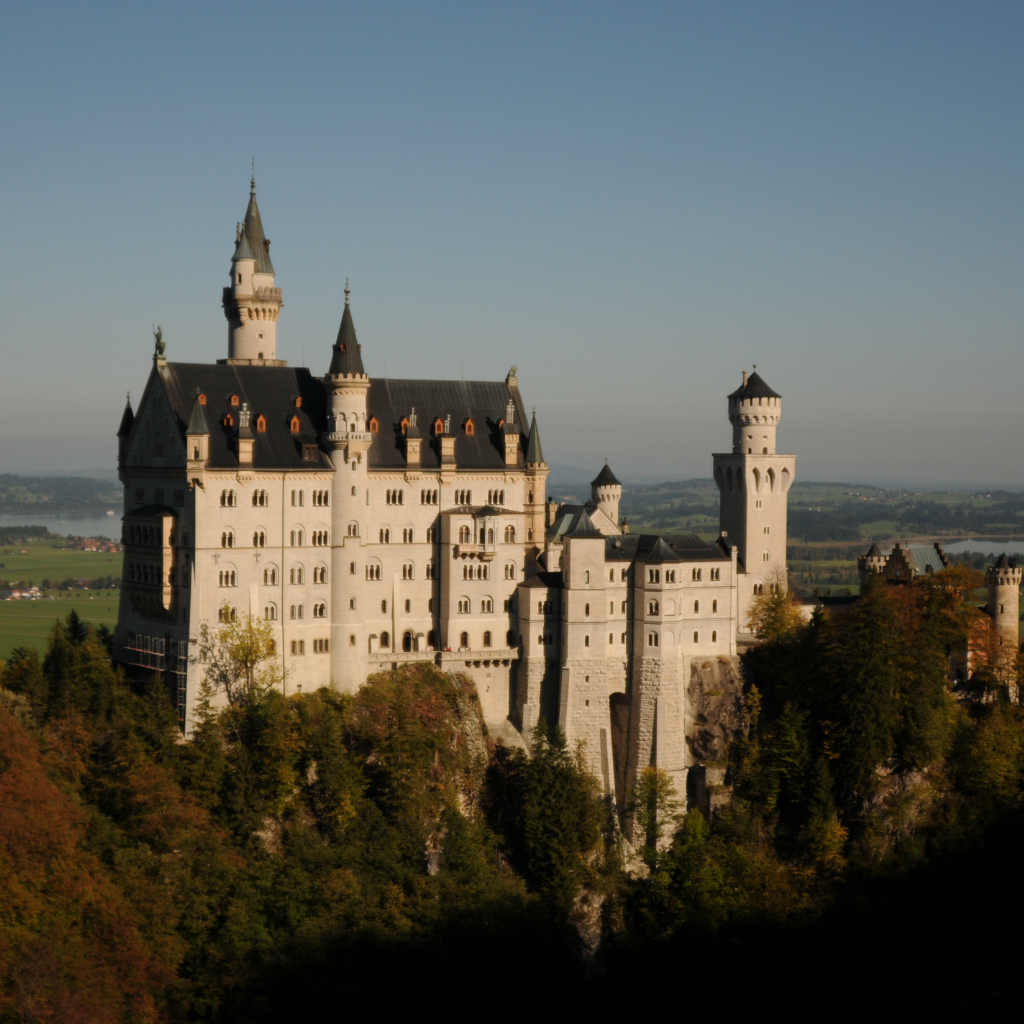
Within ten minutes of leaving Dachau's surrounding area we were back in alpine Germany and the contrast was absolute. The mountains appeared. The landscape turned green and impossible. Matt settled into the Autobahn with what I can only describe as joy, driving at whatever speed he chose and shouting random German words out the window to express excitement. The drive took an hour and a half and it was the most beautiful driving we've done anywhere. Perfectly maintained countryside the entire way. Then the castle appeared at the top of the mountain with the Alps rising behind it.
We stayed at Villa Jagerhouse, which sits directly between the two castles, Neuschwanstein and Hohenschwangau. Our room had a view of Hohenschwangau from the window. At a local restaurant with a full view of both castles, we had our first proper German meal of the trip: beer, pretzel, and sausage. The pretzel alone was worth the flight. Enormous, crunchy on the outside, perfectly soft inside, nothing like what gets sold as a pretzel at home. I said at the time that it reminded me of the first real bagel I had on the East Coast after years of eating the dense hockey-puck version on the West Coast. Pretzels have a correct form and Germany knows what it is.
Matt's last-minute decision to catch the final bus up to Neuschwanstein for sunset turned out to be one of the best decisions of the trip. The light on the mountains. The castle above. Perfect in a way you want to hold onto.
Dinner that evening included pork knuckle with dumpling and sauerkraut for me and deer with spaetzle and Brussels sprouts for Matt. A nice bath in the hotel's excellent tub. I read the Hunger Games until I remembered Germany came first.
Tour of both castles the next day: Hohenschwangau first, where King Ludwig II grew up and watched Neuschwanstein being built across the valley. Then Neuschwanstein itself, which is the castle Disney's Sleeping Beauty castle is directly modeled after. Ludwig lived in it for only 172 days. He was arrested there, declared unfit to rule, and found dead by a lake outside Munich the following day under circumstances that have never been explained. The interior was only thirty percent completed when construction stopped. Within six weeks of his death people were paying to tour it. Our Rick Steves guide called the interior underwhelming compared to Hohenschwangau. Rick Steves was wrong. The level of detail in every finished room, the paintings and woodwork and mosaic floors, was extraordinary. No photos allowed inside either castle, which is a rule that exists and is enforced and which made us sad.
We hiked up to the St. Mary's Bridge both evenings for photos from the best vantage point. People leave engraved locks on the fence there, names joined together. Romance at its best. On the walk back down we stopped for a liter of beer, which is the size of Matt's head. I am not exaggerating.
From the castle we drove to Mittenwald, deep in the Alps, through Oberammergau and the most beautiful stretch of road we'd driven yet. The guesthouse we stayed at was run by a warm and friendly woman who gave us a dinner recommendation with a specific endorsement: a chef who had received stars at his previous restaurant in another town had moved to Mittenwald, opening without stars, and she said his cooking was top notch. She was completely right. The restaurant was cozy and they brought us Prosecco to start. The chef came out and gently asked if we spoke any German. We did not. He tried to describe the tasting menu in basic English. We said "four courses, yes please" and let him do his thing. Every course was extraordinary. We took a walk through the lit-up town after dinner in the crisp mountain air before coming back to sleep.