Africa | Europe | Middle East | South Asia | China | Latin America | Nordic
The City That Made Us Walk Ten Miles a Day Just So We Could Keep Eating
Latin America | Spring 2025
Mexico City wasn't on the original lifetime pity list the way Machu Picchu or Petra was. It snuck up on us. You hear enough people describe CDMX as one of the greatest food cities on earth, and eventually that becomes its own kind of pull. A city of 22 million people with a culinary tradition going back thousands of years, a history so layered it practically has its own geology, and a street food culture that makes you rethink everything you thought you knew about what tacos could be.
Then we watched a Joshua Weissman YouTube where he literally ate tacos across the whole city for like 16 hours straight and we knew we had to go, so we went. We walked constantly. We ate constantly. We had the altitude to contend with. And we came home already talking about going back.
One thing nobody tells you enough about Mexico City before you go: it sits at 7,350 feet above sea level. That's higher than Denver. If you've done any high-altitude travel before (and we have, hello Cusco), you know that your body's reaction to that is its own thing entirely, unpredictable and occasionally humbling.
We were cautious about it going in. The first day we took it easy, drank water aggressively, and paid attention to how we felt. By the second day we both felt completely normal, which was a genuine relief. When altitude behaves, it changes the whole shape of the trip.
We spent a morning on a guided food tour of Mexico City's history with the Aztec capital Tenochtitlan literally under your feet and the Spanish colonial architecture built on top of it. The whole place is one civilization written over another.
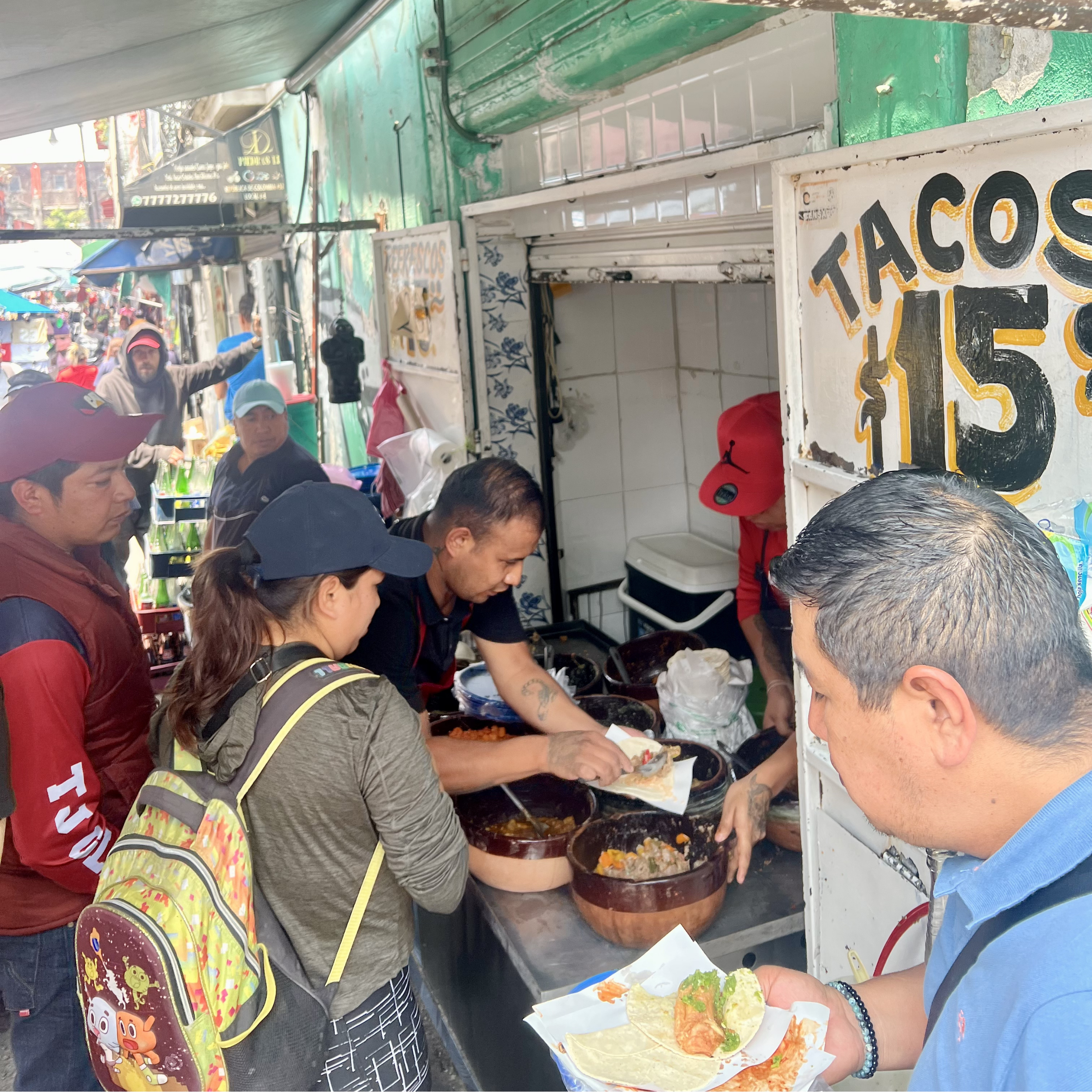
There were several food stops woven into the tour, which is exactly how it should be done. Street vendor tacos and a stop at a local market. Not restaurant tacos. Street tacos from people who've been making them the same way for years, served on small tortillas with cilantro and onion and whatever salsa you choose from the row of containers on the cart.
There's a moment on any good food tour where you stop thinking about what you're tasting and start just tasting it. That happened early in CDMX. The food has a directness to it. Nothing is trying to be anything other than what it is.
We had dinner in the “trendy” area of the city with an octopus tostada to start. Now, We’ve had octopus a lot of places at this point, but a well-executed tostada is its own thing: the crunch of the tortilla, the tenderness of the octopus, whatever acid and heat the kitchen is working with. This was excellent.
Then nopal tartar. Nopal is cactus, and it's one of my favorite things in Mexican cooking. The texture, the slight tartness, the way it takes on whatever it's dressed with. As a tartar it was unexpected and completely right.
The dish that got us both was the flautas with bone marrow. Flautas are crispy rolled tacos, and serving them with bone marrow is the kind of decision that sounds indulgent to the point of excess and then turns out to be exactly as good as you hoped. Rich and savory and the kind of thing you talk about on the way back to the hotel.
We went to a seafood-focused restaurant for lunch on day two and I want to be clear that ordering more octopus was a completely deliberate choice and I would make it again.
The Mexican shrimp cocktail also deserves a moment here because it is not what you might be imagining. It's not cold boiled shrimp with cocktail sauce. It's a glass or bowl of citrus-bright, slightly spicy shrimp in a tomato and clamato-based liquid with avocado and cucumber, and you eat it with tostadas and it is one of the most refreshing things you can put in your body, especially when you've been walking in the sun all day.
The Baja-style fried fish tacos were the third anchor of that lunch. Crispy battered fish, crema, shredded cabbage, a lime wedge. Simple in theory, and in the right hands completely perfect.
We saved the best tacos for last, which was either a stroke of planning genius or just luck, and I'm going to claim it was intentional.
Birria tacos. If you haven't had proper birria, it's braised meat (traditionally goat, often beef in modern variations) with a consomme for dipping. You take the taco, you drag it through the broth, you eat it. Then you drink the consomme. It is the kind of food that makes you slightly angry at every other version of it you've had before, because now you know what it's supposed to taste like.
These were the best birria tacos we'd ever had. That's not hyperbole. We both said it at the same time.
The final dinner was at our hotel's rooftop restaurant, looking out over the Zócalo and the old city below. The Zócalo is one of the largest public squares in the world, and at night with the lights and the cathedral and the Palacio Nacional framing it, it's a genuinely spectacular view.
Mexico City operates at a scale that should feel overwhelming and somehow doesn't. It's enormous and alive, and yet within a few hours of arriving you find your rhythm in it. You start to understand the neighborhoods. You figure out what you're eating next. You stop worrying about the altitude.
The food is the obvious headline, and it fully deserves to be. But its real heart is its deep history AND extraordinary food AND the specific energy of a city that has been continuously inhabited and continuously fed for thousands of years. And did I mention the best churros of your life are here? Ok…Barcelona may tie for this award, but still…you don’t know how amazing a churro can be until you’ve had one here.
Protests, Parades, Peas, and a Dog Who Saved Me
Peru | Cusco | June 2010
Getting from Machu Picchu to Cusco involved what can only be described as a genuinely spectacular logistical mess. The floods had washed out the railway in multiple sections, so after the train portion ended we were loaded into vans for a two-hour drive on dirt and gravel roads, partly on actual train tracks, in complete darkness, with dogs running into the road, people appearing out of nowhere along the edges, and a driver who slowed from 45 miles per hour to nearly a complete stop at every speed bump before accelerating immediately again.
Our bus companions were college boys who used the word "bro" at a frequency I cannot accurately convey, and two elderly women with strong opinions about the appropriate use of an Incan flute. One of the boys was playing it quietly. One of the women told him to stop. He apologized and said he hadn't meant to bother anyone. She told him: "Yes you did. Practice when you are by yourself." Honestly, fair. We got into Cusco at ten-thirty at night, checked into our hotel, showered, and fell directly asleep.
Morning changed everything. The hotel owner, an American woman in a Lakers hat who had clearly figured out the city thoroughly, handed us a map with her personal recommendations circled and sent us to Jack's Cafe for breakfast. Her exact words were that they had great eggs and great cappuccino. She was right on both counts. My eggs with garlicky mushrooms and bacon over toast tasted profoundly, aggressively non-Peruvian and I enjoyed every single bite without an ounce of guilt.
The old part of Cusco where tourists stay is genuinely lovely: hilly and historic, with beautiful colonial architecture surrounding the main plaza. Very different from the scrappy outskirts we had driven through on our first arrival day. The Plaza de Armas was our first stop, where we encountered a nationwide protest over gas prices in full swing. They had made large paper rats with politicians' faces on them and were lighting them on fire. There were M-80s going off and cheering. We watched for a while, decided we were not in any danger, and wandered the streets for the rest of the day shopping and exploring. We had been told the protest might affect transportation and were very relieved it hadn't touched our Machu Picchu timing.
The next morning the protest had given way to something better: a two-day festival in the Plaza, which turned out to be a traditional Peruvian dance competition. Schools and towns performing in full costume, one after another, all day long. We sat and watched for a while before heading to the local market, which is our favorite kind of travel activity anywhere in the world.
The market in Cusco is where the whole city goes for everything: meat, produce, spices, household needs, all of it under one large roof. Matt was very happy with the photo opportunities, particularly in the "special" section that offered tongues, heads, innards, and fetuses alongside the regular cuts. I found handmade wooden cooking spoons for a dollar each and bought several. Matt found shelled sugar snap peas in large bags for one sole, which converts to about thirty-five cents and which he calculated was roughly the equivalent of ten dollars worth at home. He bought a bag, ate most of it standing there, and went back for another. Outside the market we bought fresh pork rinds (my one guilty admission) and more of the toasted corn we had been obsessed with since Machu Picchu.
Lunch that day at a restaurant owned by a well-known Peruvian chef was our most disappointing meal of the trip. This became a pattern we noticed throughout Peru: restaurants have a tendency to overcook their meat to the point of real toughness, and this was no exception. Peru was wonderful in many ways and is not going to be remembered for its restaurant food, with a few exceptions. The market food, the street food, the home cooking at places like the Green House? Excellent. The restaurant experience was more variable.
Dinner that night at Inka Grill right on the plaza was the exception. Matt ordered alpaca with quinoa, his new food obsession that started in Peru and continued well past the trip, and it was cooked significantly better than any alpaca we'd had elsewhere. They had live music. It was a genuinely nice last full evening.
Our final day I woke up at 5:30 in the morning feeling like I was dying.
Worst headache of my life. Completely dehydrated. What I had been so focused on was making sure Matt was drinking enough water at altitude that I had apparently forgotten to apply that logic to myself. I downed aspirin, drank a full bottle of water, went back to sleep, and woke up feeling exactly as bad. Freezing despite it being a warm day. Zero energy. Zero appetite. Achy in the specific way that feels like every cell in your body is protesting.
In the true spirit of not letting altitude sickness win on our last day, I rallied and made the hike up to Sacsayhuaman, a massive Incan fortress of enormous stone blocks above the city, visible from almost everywhere in Cusco. This was a straight uphill climb on uneven terrain at already-considerable altitude while fighting what was very possibly a fever. I had to stop constantly. At one point I genuinely wondered if I was going to make it. A stray dog attached himself to us at the base and hiked the whole way up alongside us, sitting with me every single time I stopped, watching me with what I choose to interpret as concern rather than judgment. He stayed with us at the ruins too. We were very bonded by the end.
Matt forced two more bottles of water and Aleve into me at the ruins. I still did not feel better. We took a taxi back down, a decision I made without regret. Matt found me Gatorade. I napped. The hotel owner saw me and said immediately: "altitude." He suggested coca tea. Three or four cups later my headache had actually started to ease. By seven that evening I thought the fever had broken. Not one hundred percent, but better enough to appreciate that the day had not, in fact, killed me.
Matt, meanwhile, having force-hydrated me into basic functionality, spent the afternoon at a second market he found across the street from the first one that was more local and less tourist-facing. No other foreigners, more photo opportunities, more peas. He came home satisfied.
We watched a movie, did not go to dinner, went to sleep.
A few Peru observations that I want to leave on record, because every trip produces them. Restaurants cut their already-thin paper napkins in half or even into quarters. You cannot flush toilet paper down the toilets anywhere except your hotel, everything goes in a waste can next to the toilet, which is a cultural adjustment that you make quickly. The streets of old Cusco are polished stone, worn smooth by years of car traffic, and the slightest moisture makes them genuinely treacherous: we nearly went down several times on small hills. Security officers here whistle constantly and seemingly at nothing in particular, as though the whistling itself is the job. The salt at every restaurant tastes like nothing, which baffled us. The cappuccinos are excellent everywhere, which delighted us. And the urine smell that permeates many streets is a fact of life that a good rain would solve, and which Peru seems in no particular hurry to address.
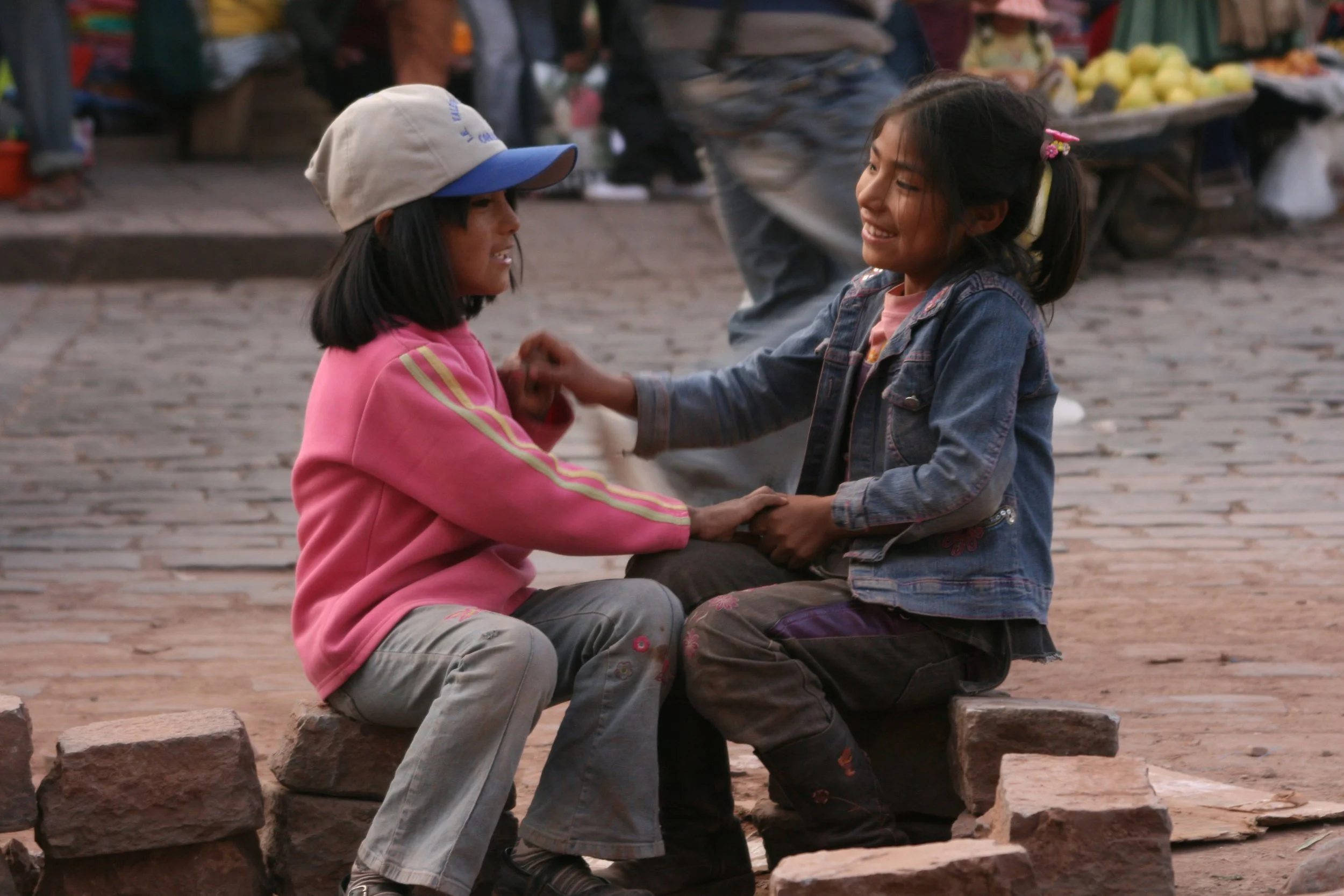
What Peru leaves you with, underneath all of it, is the same thing that every trip like this leaves us with. Gratitude and perspective. Most of the people we met in Peru will never leave their town or their village. What strikes you every time is not the poverty itself but what accompanies it: the friendliness, the pride, the eagerness to help, the genuine happiness in the daily interactions. People who have very little and give what they have freely. That kid who gave me wooden pyramids at Giza. Fahti in Cairo who spent an entire evening showing us his city. The dog who hiked Sacsayhuaman with a sick American woman and stayed beside her every time she needed to stop.
Muchas gracias, Peru. We will not forget you.
The Dream I Had at Thirteen & One Less Lifetime Pity
Peru | Aguas Calientes + Machu Picchu | June 2010
I was in seventh-grade Spanish class when my teacher Ms. Flynn showed us slides from her trip to Machu Picchu. She talked about the magic of it, the wonder, all while teaching us about the Inkas. I remember sitting at my desk and thinking, clearly and with complete conviction: I am going to go there someday.
That was age thirteen. I was thirty-two when I stepped off a bus at the entrance to Machu Picchu and started climbing. Nineteen years in the making. And within five minutes of climbing, through the lack of oxygen and the burning in my legs, there it was. As magnificent as I had always imagined it to be.
I got emotional. I did not expect to get emotional, but there it is. Nineteen years is a long time to carry a dream around, and some dreams deserve a little crying when they come true.
Getting there was its own adventure. Peru Rail had just resumed operating after devastating floods the previous year wiped out large sections of the railway. We boarded buses from Ollantaytambo and drove for an hour on actual train tracks in some sections, through farmland, and along bumpy roads until we reached a station where the train was waiting. While we waited to depart, an older woman on the platform was selling toasted corn for one sole per bag. We bought one and ate it on the train. We wished we had bought ten.
The train itself was wonderful, a class called the Vistadome with windows that curve up into the ceiling so you can watch the mountains rise around you as you descend into the cloud forest. Our boxed lunch arrived and our attendant opened it with great ceremony to explain its contents: "We have a ham and cheese sandwich, and the ham is turkey." We looked at each other. Perfect.
The journey took about an hour and twenty-five minutes to reach Aguas Calientes, the town at the base of Machu Picchu where almost everyone stays overnight. We checked in fast, dropped our bags, and headed straight for the bus that spirals up the mountain. And I do mean up. The road is a series of aggressive switchbacks carved into the face of the mountain, and the bus takes them with confidence.
Then you climb the final stretch on foot, and then there it is.
Machu Picchu is set among a mountain range in a way that seems almost too perfect, steep green slopes dropping away on every side, the ruins perched on their ridge like they grew there. The views rival Guilin, China for us, and Guilin is extraordinary. We spent the afternoon exploring, intentionally leaving sections for the next morning. That evening in Aguas Calientes we sat outside a small cafe, me with a cappuccino (Peru makes surprisingly excellent cappuccinos), Matt with a Peruvian beer, listening to traditional music from somewhere down the street. Then dinner at a restaurant called The Tree House for our anniversary: Matt had Alpaca tornadoes, I had a quinoa risotto with chicken that we had first encountered as a side dish in Ollantaytambo and loved enough to order as a full plate. Then we sat in an internet cafe watching a man do a note-perfect Michael Jackson moonwalk on the street outside in full Thriller jacket and hair. Not something we expected from Aguas Calientes, Peru, but travel keeps surprising you.
Day two at Machu Picchu started at 4:30 in the morning because we wanted to be there at opening, which is 6am, and the entire town apparently had the same idea. The bus line at that hour was impressively long. We made it. Sunrise was honest but not dramatic, no spectacular color variation, just dark and then lighter and then blue, but there is something genuinely worth doing about watching that happen while you're already inside Machu Picchu with almost no one else around yet.
We started from the bottom that morning, exploring ruins we had skipped the day before while most of the early crowd gathered at the top for photos. By the time we were ready to go up for the overview, they were all coming down. This is the move. Come early, start low, work against the crowd. You'll have large sections nearly to yourself.
We hiked out to an original Incan bridge, which is on the side of the mountain and approximately three feet wide with nothing between you and a very long drop. The Incan civilization was, to put it mildly, not afraid of heights. We stood there and looked at it and agreed that nobody from our era designed this.
One thing nobody tells you quite enough about Machu Picchu is how physically demanding it is. You are not strolling on maintained pathways with handrails. You are scrambling up and down stairs from the fifteenth century that range from six inches to two feet high in the same flight. Uneven rocks, gravel surfaces, paths along edges with absolutely nothing between you and a thousand-foot drop. No ropes, no rails, no safety infrastructure of any kind. We loved it. It also means every single step requires your full attention, which is a surprisingly meditative way to spend a morning.
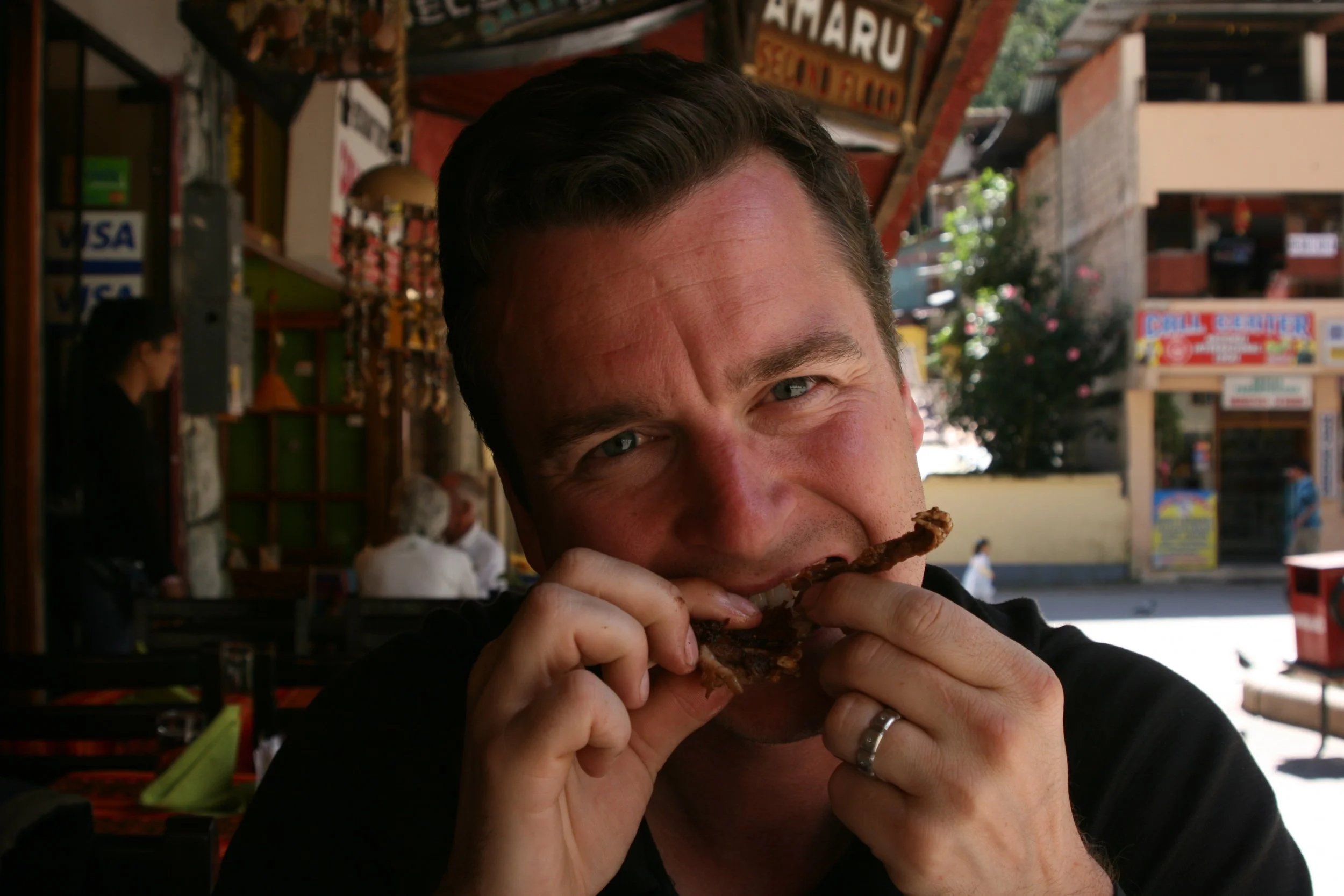
We were finished by ten-thirty, took the bouncy switchback bus back down, and had lunch in town. And this is when Matt finally got his Cuy. Guinea pig. A Peruvian delicacy. He had been talking about ordering it since we arrived in the country and here was his moment. The photos document the experience thoroughly. Not a lot of meat on a guinea pig, it turns out. He liked it. I respected his commitment.
Machu Picchu is one of the wonders of the world, and I want to say something about that word: wonder. It can be used carelessly in travel writing, as a synonym for "impressive" or "beautiful." Machu Picchu earns it in the original sense of the word. You wonder how. You wonder why. Its purpose and history remain genuinely unknown: most of what guides and books tell you is speculation based on what we already know of Incan civilization broadly. A place the size of Machu Picchu, at that altitude, with that level of construction and engineering, abandoned and lost for centuries and then rediscovered in 1911, and we still do not really know what it was for. That not-knowing makes it more remarkable, not less.
That dream I had at thirteen was worth every year of waiting.
Peas, Alpaca, and a Valley That Doesn't Feel Real
Peru | Sacred Valley + Ollantaytambo | June 2010
South America. Our first time crossing the equator, and we were giddy about it in the way you only get when a place has been on a list in your head for a long time. We took the overnight flight from JFK to Lima, managed to actually sleep reasonably well for once, and landed in Peru feeling functional. A quick layover in Lima, a last Starbucks because we had no idea when we'd see another one, and then a 55-minute flight to Cusco.
Landing in Cusco is one of the stranger aviation experiences you'll have. You go up in the plane but you never really feel like you descend. You're flying alongside mountains, level with their peaks, and then suddenly you're touching down. The altitude is immediately, personally apparent at 11,152 feet. The prescription medication we'd gotten before leaving helped, but nothing fully prepares your lungs for the realization that air is doing less work up here than you're accustomed to asking of it.
Our taxi driver Raul was waiting with a nicely printed sign and Winnie-the-Pooh stickers decorating the dashboard, which we found immediately charming. The cab had several broken parts and seatbelts that didn't function, which by this point in our traveling lives we had stopped questioning. We looked out the side windows, as is “our policy,”and took in our first impressions of Cusco. More third world than we'd expected: impoverished in a way that reminded us of Egypt and China, with dilapidated buildings, unpaved streets, and plenty of dust and dogs. The dogs especially. They were everywhere, every breed and size, wandering freely. Our instinct was that they were all strays, but our B&B host Brian told us later that almost every house in Peru has a dog. Everyone here likes to feel protected. The dogs looked healthy, just dusty, the same way the people looked: not starving, just living at a different economic register than we were used to.
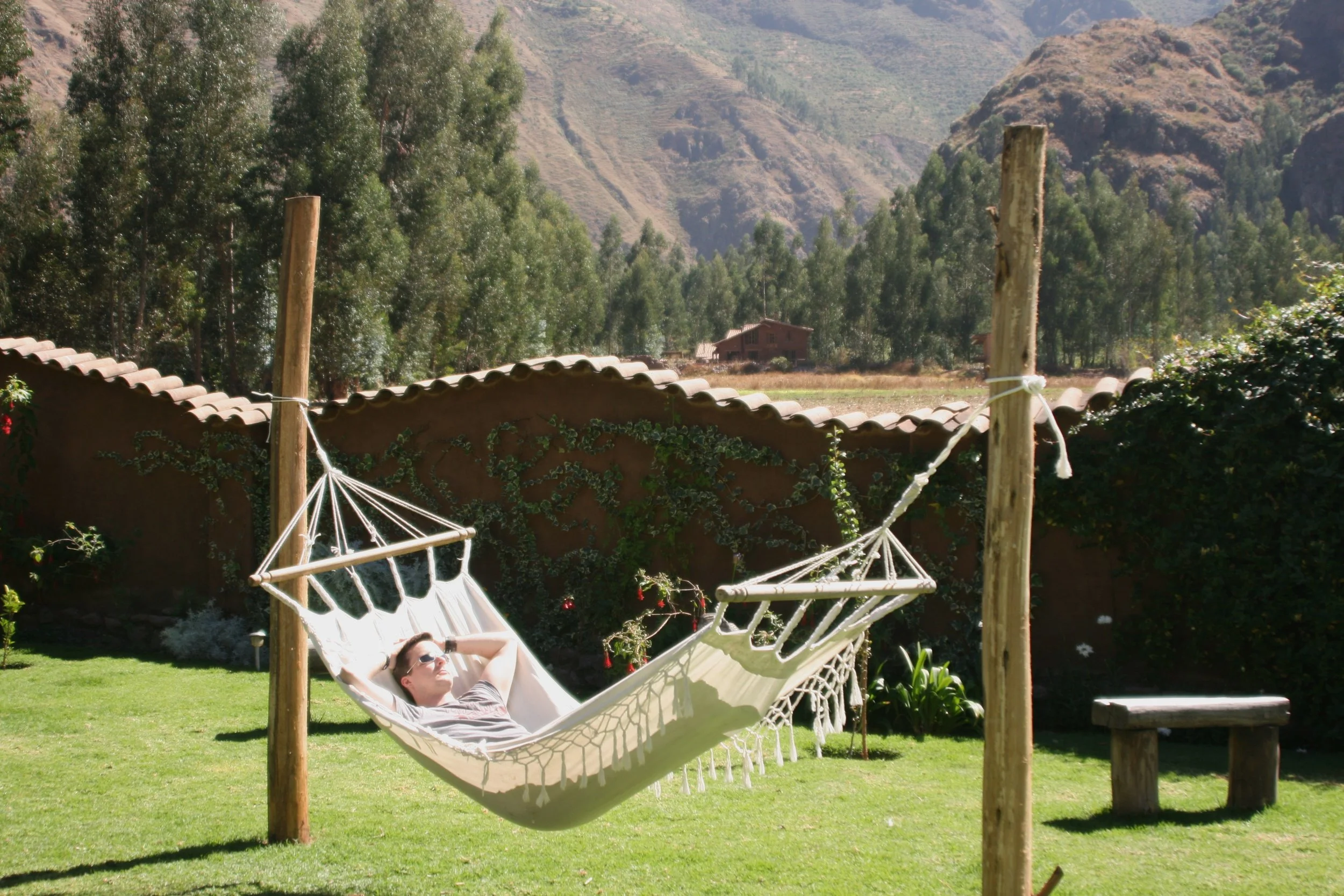
We were staying in the Sacred Valley about an hour outside of Cusco, at a place called The Green House in the village of Huaran. Trip Advisor led us there and Trip Advisor was absolutely correct about it. The Green House sits in what feels like the middle of nowhere, surrounded by mountains on every side with a small river rushing past it and gardens and lawn that seem improbable given the surrounding landscape. Think of a meditation retreat tucked into the Andes. Our room had wood-beam ceilings and an authentically rustic feel with a completely modern bathroom, which is exactly the combination you want. Hosts Gabriel and Brian have three dogs named Paco, Leica, and Yana who treated us immediately as part of the household.
That first afternoon we took the local bus to Pisac, which on a Sunday holds one of the biggest markets in the Sacred Valley. One dollar for the thirty-minute ride. The market is wonderful: alpacas are a serious business in Peru, which means alpaca products are everywhere you look. Sweaters, scarves, wraps, blankets. And baby clothes.
Lunch in a Pisac cafe was a proper three-course meal for sixteen soles, which works out to four dollars. We started with a salad inside a half avocado, moved to a traditional Peruvian corn and potato soup, had our mains, and were given a small glass of something at the end that tasted like warm wassail.
Back at the Green House by five, when the sun drops and the temperature drops with it quite suddenly, we settled into the common room where Gabriel had lit candles and a fire and put out wine and was playing good music. He cooks a three-course dinner every evening for the guests. It was the kind of evening that makes you want to stay longer than you planned. And when we finally climbed into bed, we discovered that Gabriel had tucked hot water bottles under the covers. There is no heat in the rooms. It was cold. Those hot water bottles were perhaps the single greatest hospitality gesture of any trip we have ever taken. We were asleep within thirty seconds and slept eleven hours straight.
Day two started with Gabriel's breakfast: fruit salad, scrambled eggs, bread with homemade local jam, fresh squeezed orange juice, and French pressed coffee. Then a hike to the nearby waterfall with Leica as our guide, a forty-minute walk each way through countryside where you cannot pass a single person without them saying "Buenos dias." Leica got distracted by other dogs a couple of times but overall kept us on track admirably.
The altitude made itself known on that hike in a very direct way. We had prescriptions that were helping, but even so: what should have been a gentle stroll produced an embarrassing amount of huffing and puffing. You stop for no apparent reason. You are just out of breath standing on a path. The air simply contains less of what your lungs are looking for and they let you know about it constantly.
After the waterfall we took a taxi to Ollantaytambo, which is genuinely fun to say out loud and even more fun to try to say quickly. It is the only original intact Incan city still in existence: the original roads, the original layout, many of the original buildings now occupied by families and small businesses going about their daily lives. It is, in the most literal sense, a living ruin.
The site above the town features enormous terraces that once guarded the Incan complex, one of the very few places where the conquistadors lost a significant battle. In 1536 the Incans held them off with arrows, spears, boulders, and then flooded the plain below. Standing on those terraces and understanding what happened there gives the stones a weight that history books can't quite replicate.
We climbed to the top, stopping more times than we would have liked to admit to simply breathe. The view from the top was worth every undignified pause. We had lunch in a local cafe and ordered Alpaca, which is served here the way chicken is served elsewhere: it's just the protein on the menu. Ours was a little tough but came with a good sauce and proper vegetables, and the Peruvian beer was genuinely excellent. Our taxi driver back to Huaran spoke limited English and I relied entirely on my high school Spanish, which is somewhere between "functional" and "optimistic." We had what I can only describe as the general shape of a conversation, and he was kind enough to slow down and meet me where I was. It felt like a small victory.
That evening, another fire and another of Gabriel's dinners. Tomorrow: the train to Machu Picchu.